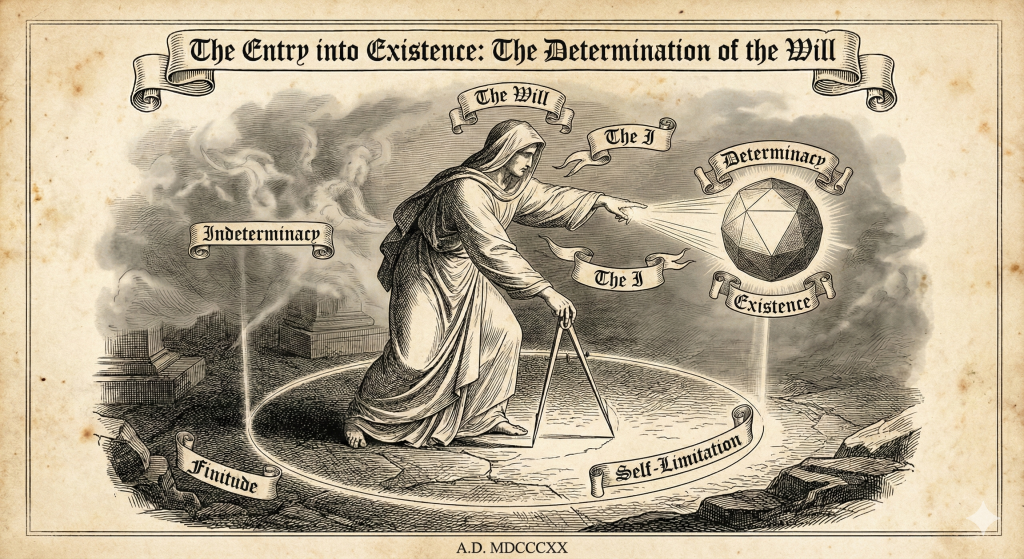
β) Likewise, the I is the transition from undifferentiated indeterminacy to differentiation, determining, and the positing of a determinacy as a content and object. — Whether this content is further given by nature or produced from the concept of spirit, through this positing of itself as something determinate, the I enters into existence in general; — the absolute moment of the finitude or particularization of the I.
This second moment of determination is just as much negativity, a negating, as the first — namely, it is the negation of the first abstract negativity. — Just as the particular in general is contained within the universal, so this second moment is already contained within the first and is only a positing of what the first already is in itself; — the first moment, as the first for itself, is not true infinity or concrete universality, the Concept, — but only something determinate and one-sided; precisely because it is the abstraction from all determinacy, it is itself not without determinacy; and being an abstract, one-sided thing constitutes its determinacy, deficiency, and finitude. — The distinction and determination of the two moments mentioned is found in Fichte’s philosophy, as well as in Kant’s, etc.; yet, to stay with Fichte’s presentation, the I as the unlimited (in the first proposition of Fichte’s Wissenschaftslehre) is taken entirely as something positive (thus it is the universality and identity of the understanding), so that this abstract I is supposed to be true in itself, and consequently limitation — negativity in general, whether as a given, external limit or as the I’s own activity — is added (in the second proposition). — To grasp the negativity immanent in the universal or identical, such as in the I, was the further step that speculative philosophy had to take — a need of which those have no inkling who do not even grasp the dualism of infinity and finitude in its immanence and abstraction, as Fichte does.