6

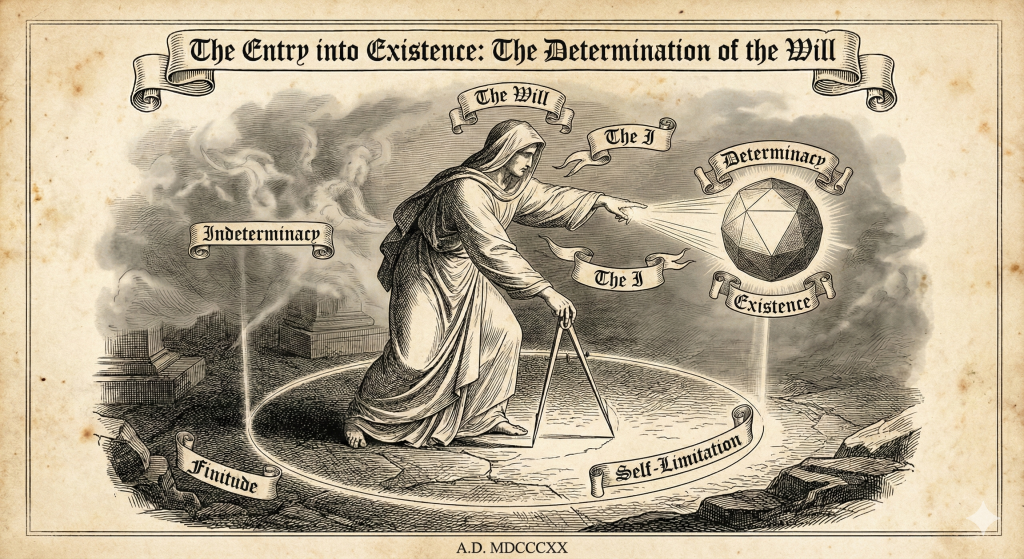
β) Likewise, the I is the transition from undifferentiated indeterminacy to differentiation, determining, and the positing of a determinacy as a content and object. — Whether this content is further given by nature or produced from the concept of spirit, through this positing of itself as something determinate, the I enters into existence in general; — the absolute moment of the finitude or particularization of the I.

|18| This second moment of determination is just as much negativity, a negating, as the first — namely, it is the negation of the first abstract negativity. — Just as the particular in general is contained within the universal, so this second moment is already contained within the first and is only a positing of what the first already is in itself; — the first moment, as the first for itself, is not true infinity or concrete universality, the Concept, — but only something determinate and one-sided; precisely because it is the abstraction from all determinacy, it is itself not without determinacy; and being an abstract, one-sided thing constitutes its determinacy, deficiency, and finitude. — The distinction and determination of the two moments mentioned is found in Fichte’s philosophy, as well as in Kant’s, etc.; yet, to stay with Fichte’s presentation, the I as the unlimited (in the first proposition of Fichte’s Wissenschaftslehre) is taken entirely as something positive (thus it is the universality and identity of the understanding), so that this abstract I is supposed to be true in itself, and consequently limitation — negativity in general, whether as a given, external limit or as the I’s own activity — is added (in the second proposition). — To grasp the negativity immanent in the universal or identical, such as in the I, was the further step that speculative philosophy had to take — a need of which those have no inkling who do not even grasp the dualism of infinity and finitude in its immanence and abstraction, as Fichte does.

DE ES


Comments

3 responses to “6”

  1. Hegel (Notes) Avatar
    Hegel (Notes)

    [zu § 6] Something – determined as mine.
    Not yet here: I will something – but rather the direction of the will toward something – particularization – reflection – choice – having this and that before me in choosing
    β)
    αα) I do not merely will, but will something, i.e. a particular – as distinct from universality – with regard to universality – determine – I limit myself – this to be considered more closely afterward in its opposition
    ββ) To limit – negation – as a deficiency – the unlimited [held to be] more excellent – as a limitation – one gives up one’s freedom – descends from one’s height – as one hears of limits, a longing to go beyond – abstraction – the question is, wherein do the limits lie? – as a matter of necessity, of finitude.
    γγ) One tells a man – he ought to keep his will limitless, not will anything determinate – money, house, your welfare, the happiness of men, of the state – always something particular – you limit yourself – must stop at mere, pure willing, not step into finitude.
    Debasement – dissatisfied – he ought to will nothing –
    δδ) he is right – for precisely that abstraction is the limit
    εε) the indeterminate just as much as the determinate – the infinite just as much as the finite – passing back and forth from one limit (but only) to another – both belong to the understanding – the negation of this understanding is itself infinite.

  2. Eduard Gans (Additions) Avatar
    Eduard Gans (Additions)

    This second moment appears as the opposite one; it is to be grasped in its general character: it belongs to freedom, but does not constitute the whole of freedom. Here the I passes from undifferentiated indeterminacy to differentiation, to positing a determinacy as a content and an object. I do not merely will, but I will something. A will that, as was set forth in the previous paragraph, wills only the abstractly universal, wills nothing and is for that reason no will at all. The particular that the will wills is a limitation, for the will, in order to be a will, must limit itself in general. That the will wills something is the limit, the negation. Particularization is thus what is customarily called finitude. Reflection ordinarily takes the first moment, namely the indeterminate, to be the absolute and higher, and by contrast takes the limited to be a mere negation of this indeterminacy. But this indeterminacy is itself only a negation as against the determinate, as against finitude: the I is this solitude and absolute negation. The indeterminate will is to that extent just as one-sided as the will that stands merely within determinacy.

  3. Hegel (Simple) Avatar
    Hegel (Simple)

    § 6: The second step of the will (making a decision)

    The will can say no. But it does not stay in the emptiness. That is the second step.

    The I moves on to making distinctions. It gives itself a content. It chooses.

    Where the content comes from does not matter here. It can come from nature, like hunger. It can come from spirit, like a plan. The I makes it its own.

    When I determine myself in this way, I enter into existence for the first time.

    The price: This makes me finite. Before, I was infinite, because I could have been anything. Now I am someone definite: this person, with this job, in this place. I have limited myself. But without this step, I would not be there at all.

    The most important point: The second step does not come from outside and join the first. It is already inside the first.

    Let us look at the first step more closely. It means looking away from everything definite. But this makes it something definite itself: just looking away from everything, and nothing else. It is one-sided. It is not yet true infinity. So the second step only brings out what the first already was.

    Fichte’s mistake: Fichte, and Kant too, already saw the two steps. But Fichte first takes the I as something purely positive, as the unlimited. Only after that does the limit come in. So it looks as if the I runs into a boundary.

    We say: No. The limit is not something extra. The I sets it itself. Negation is in the I from the very beginning. Seeing this was the next step that philosophy had to take.

    Summary: If you want to be real, you must have the courage not to be everything. And this limit does not just happen to us. We set it ourselves.

Leave a Reply