7

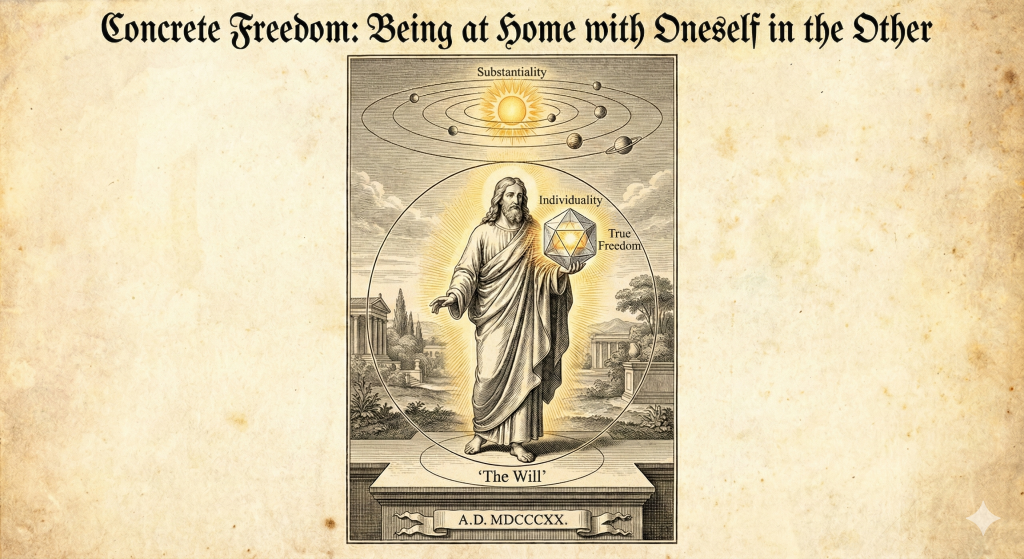
γ) |19| The will is the unity of these two moments; — particularity reflected into itself and thereby brought back to universality; — individuality; the self-determination of the I, at once to posit itself as the negative of itself, namely as determinate and limited, and yet to remain with itself, i.e., in its identity with itself and its universality, and in this determination to join together only with itself. — The I determines itself insofar as it is the relation of negativity to itself; as this relation to itself, it is likewise indifferent to this determinacy, knows it as its own and as ideal, as a mere possibility by which it is not bound, but in which it only exists because it posits itself therein. — This is the freedom of the will, which constitutes its concept or substantiality, its gravity, just as gravity constitutes the substantiality of a body.

Every self-consciousness knows itself as universal — as the possibility of abstracting from everything determinate — and as particular, with a determinate object, content, or purpose. These two moments, however, are only abstractions; the concrete and the true (and all that is true is concrete) is universality, which has particularity as its opposite, but which through its reflection into itself is reconciled with the universal. — This unity is individuality1, not in its immediacy as a ‘one’ (as individuality is in representation), but according to its concept (Encycl. of the Philos. Sciences, § 112-114)2 — or rather, this individuality is essentially nothing other than the concept itself. |20| Those first two moments—that the will can abstract from everything and that it is also determinate (through itself or something else)—are easily admitted and grasped, because they are in themselves untrue moments of the understanding; but the third, the true and speculative (and all that is true, insofar as it is comprehended, can only be thought speculatively), is that into which the understanding refuses to enter, for it always calls the concept precisely the incomprehensible. The proof and more detailed discussion of this innermost core of speculation—of infinity as negativity relating to itself, this ultimate source of all activity, life, and consciousness—belongs to Logic as purely speculative philosophy.3 — It can only be noted here that when one says: the will is universal, the will determines itself, one is already expressing the will as a presupposed subject or substrate; however, it is not something ready-made and universal prior to its determining and prior to the sublation and ideality of this determining, but is only will as this activity mediating itself within itself and returning into itself.
  1. Hegel’s Handexemplar. better: subjectivity ↩︎
  2. Encyclopaedia, 3rd ed. § 163–165 ↩︎
  3. Hegel gives no reference. What is meant is absolute negativity: the negation that relates itself to itself and in doing so is not destroyed but stays with itself – which is also the concept of true infinity (Encyclopaedia, 3rd ed. § 95, § 160 f.). – See The Grammar of Logical Concepts: negativity and infinite. ↩︎

DE ES


Comments

3 responses to “7”

  1. Hegel (Notes) Avatar
    Hegel (Notes)

    [zu § 7] Both of these, α) β), are called freedom – they are only moments of one and the same, and of the will
    α) This third [γ] is not abstraction, but concrete, sound common sense, and speculation. Absolute form – everywhere and always – divine rhythm of the world and method of absolute cognition – noted once and for all – with this one has already gained a great deal of knowledge in advance
    β) what is speculative? – the concrete, intuition, sound common sense – misformation, reflection – philosophy back to sound common sense – immediate singularity – concept, singularity – how – speculative unity.
    Resolution – α) particularization – distinguishing – β) sublating this distinguishing – being with oneself, i.e. identical with oneself, self-consciousness
    β) Negation is implicit, indeterminacy – particularization is implicitly negation of this negation – in the next consideration – appearance – αα) indeterminacy ββ) determination, first negation appearing – stimulus of life – self-consciousness – presence – liveliness
    α) content, interest – occupation – the particular
    β) but I am only above it – particularization only as negative, as a limit –
    Often the question [arises]: how can people find satisfaction in such occupations?
    αα) content particular, substantial, but always limited
    ββ) presence – self-consciousness
    This not formal, the content in fact substantial. Degrees, stages within this substantiality.
    Singularity, better: subject –
    Universality – I am with myself – pervading – running through the subjective and the objective – true universality passes through abstract universality and through particularity – subject for me is universality only with negativity posited –
    Syllogism – will
    1. Resolving oneself – oneself – singularity – positing oneself into externality – the particular – or deciding – αα) still undetermined – manifold, particular; – sublating this indecision
    2. This third – ββ – is only the true [moment] in such a way that those moments themselves contain it within them – the universal – the sublation of the particularizations – is likewise a return into itself – but an undetermined one – and the particular – determining – is likewise subjectivity – the sublation of the abstract – the being-other as against determinacy.
    3. This return of the will into itself is the formal [moment] – at first simply – an ought-to-be; one feels at once that everything depends on the nature of the particular – whether I am indeed with myself therein; – the particular is a purpose – it is indeed formally my purpose, but it can have a content that is given to me from elsewhere, and that is different from the I –

  2. Eduard Gans (Additions) Avatar
    Eduard Gans (Additions)

    What we properly call will contains the two previous moments within itself. The I is, in the first place, as such pure activity, the universal that is with itself; but this universal determines itself, and to that extent it is no longer with itself, but posits itself as an other and ceases to be the universal. The third moment is now that it be with itself in its limitation, in this other, that, in determining itself, it nonetheless remain with itself and not cease to hold fast to the universal: this is then the concrete concept of freedom, whereas the two previous moments have been found to be thoroughly abstract and one-sided. But we already have this freedom in the form of feeling, for example in friendship and love. Here one is not one-sidedly within oneself, but rather gladly limits oneself in relation to an other, yet knows oneself, within this limitation, as oneself. In determinacy the human being ought not feel himself determined; rather, it is precisely in regarding the other as other that one first has one’s feeling of self. Freedom, therefore, lies neither in indeterminacy nor in determinacy, but is both. The will that limits itself merely to a this is possessed by the obstinate person, who supposes himself unfree if he does not have this will. But the will is not bound to something limited; rather it must go further, for the nature of the will is not this one-sidedness and boundness, but freedom consists in willing something determinate while yet being with oneself in this determinacy and returning again into the universal.

  3. Hegel (Simple) Avatar
    Hegel (Simple)

    § 7: The third step of the will (true freedom)

    Now we put the two steps together. The actual will is both in one:

    the possibility of looking away from everything,

    and the decision for one particular thing.

    What is true freedom? It does not mean dodging every decision. But it also does not mean clinging to one thing.

    It means this: I decide, I limit myself — and yet I am not trapped in it. I recognize myself in this thing. I am with myself, even when I bind myself to a task or to a person. The determination does not tie me down, for I myself step into it.

    We call this state individuality. That means: I am one quite particular person, and so I am limited. And precisely in this I am free and whole.

    A comparison: Freedom is to the will what gravity is to a body. Gravity does not press on the body from outside. It is what makes it a body. Take gravity away from a body, and no body remains. Take freedom away from the will, and no will remains.

    One more thing, and people easily overlook it. We say: “The will determines itself.” That sounds as if first there is the will and then its determining. That is not how it is. The will is not ready-made before it determines itself. It only becomes will by doing so.

    Why the understanding gives up here: Everyone admits the first two steps. Freedom as choice, freedom as commitment — that is easy to understand. For exactly this reason, neither of them is true on its own. The third step is hard: How can you bind yourself and still be free? People who do not want to think this prefer to call it impossible to grasp.

    Summary: Free is not the one who keeps all options open. Free is the one who commits and finds himself again in what he does.

Leave a Reply