1

Introduction

The philosophical science of right has as its object the “The idea in general is nothing other than the concept, the reality of the concept, and the unity of both.“ (Hegel, Lectures on Aesthetics, p. 145) of “This reality in general, as the existence of the free will, is right, which is to be taken comprehensively not only as limited legal right, but as the existence of all determinations of freedom.“ (§ 486 Enc. 1830), the concept of right and its actualization.

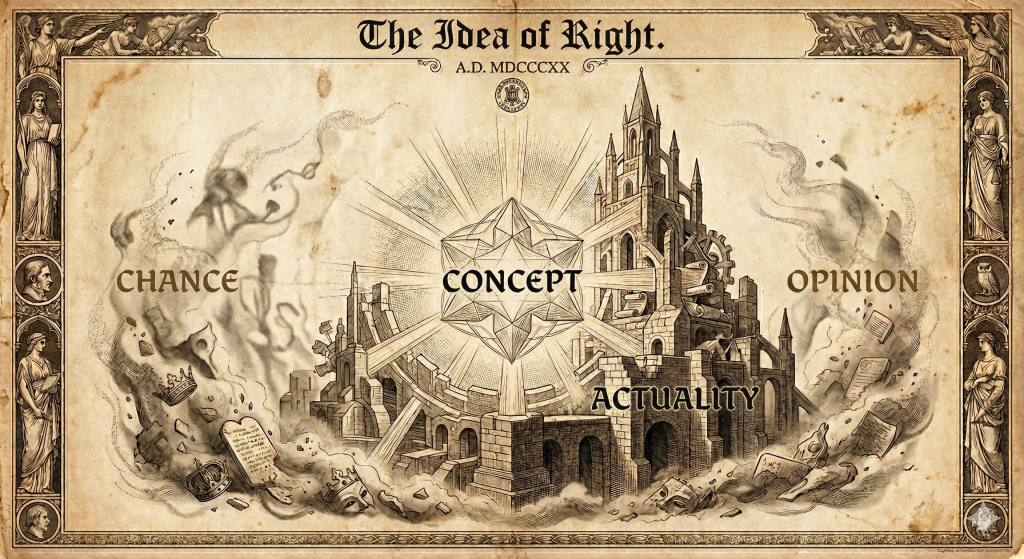
Philosophy has to do with ideas and therefore not with what are usually called mere concepts; on the contrary, it points out their one-sidedness and untruth, as well as the fact that the concept (not what is often heard called such, which is merely an abstract determination of the understanding) alone is what has actuality, and indeed in such a way that it gives this actuality to itself. Everything that is not this actuality posited by the concept itself is transient existence, external contingency, opinion, inessential appearance, untruth, illusion, etc. The configuration which the concept gives to itself in its actualization is, for the cognition of the concept itself, the other essential moment of the idea, distinguished from the form of being only as concept.
DE ES


Comments

3 responses to “1”

  1. Hegel (Notes) Avatar
    Hegel (Notes)

    [zu § 1] 30. X. 1822
    The nature of the matter
    . Not: we have these and these concepts and content – right, freedom, property, the state, and so forth – and now also think this material clearly for ourselves; – formal education is of no help in deciding the matter. Rather: to consider precisely the nature of the matter itself, this is the concept of the matter, – the former only something given, taken up from God knows where, merely represented, and so on.
    Not so-called mere concepts; philosophy knows best of all that so-called mere concepts are something null – but rather essentially their actualization – realization. Actuality is only the unity of the inner and the outer – that the concept not be a mere inward thing, but likewise something real, – and that the outer, the real, not be a conceptless reality, determinate being – existence, but rather be essentially determined through the concept. – This, within the general distinction between concept and Idea, – Idea in the philosophical sense – for now historically – I reserve the closer treatment for the concept of right – the concept of this Idea itself – for right is thoroughly only as Idea –

  2. Eduard Gans (Additions) Avatar
    Eduard Gans (Additions)

    The concept and its existence are two sides, distinct and yet one, like soul and body. The body is the very same life as the soul, and yet both can be called things lying apart from one another. A soul without a body would be nothing living, and likewise the reverse. Thus the determinate being of the concept is its body, just as this body obeys the soul that brought it forth. The seed contains the tree within itself and holds its entire power, although it is not yet the tree itself. The tree corresponds entirely to the simple image of the seed. If the body does not correspond to the soul, then this is simply something wretched. The unity of determinate being and concept, of body and soul, is the Idea. It is not merely harmony, but complete interpenetration. Nothing lives that is not in some way Idea. The Idea of right is freedom, and in order to be truly grasped, it must be recognized both in its concept and in the determinate being of that concept.

  3. Hegel (Simple) Avatar
    Hegel (Simple)

    § 1: What we study here

    In the philosophy of right, we deal with the Idea of right. The Idea is more than just a word or a thought. The Idea consists of two things that belong together:

    The concept of right (this is the inner plan or the core).

    The actualization of right (this is the existence of this plan in the real world).

    Explanation: Philosophy does not deal with empty thoughts that exist only in our heads. A true concept is strong. It does not stay abstract. It has the power to give itself actuality. It becomes real.

    Some things exist but do not come from this rational concept. We do not call them “actuality”. We call them mere “existence” or “chance”. They are like a shell without a core. They are illusion or error.

    The true Idea is the unity of both: The concept (the core) shapes the world. And the world (the shape it takes) is the body of this concept. Only when both come together do we have the truth.

    And where does all this lead? The Idea of right is freedom. This whole book leads up to this statement. We will make good on it step by step.

Leave a Reply