2

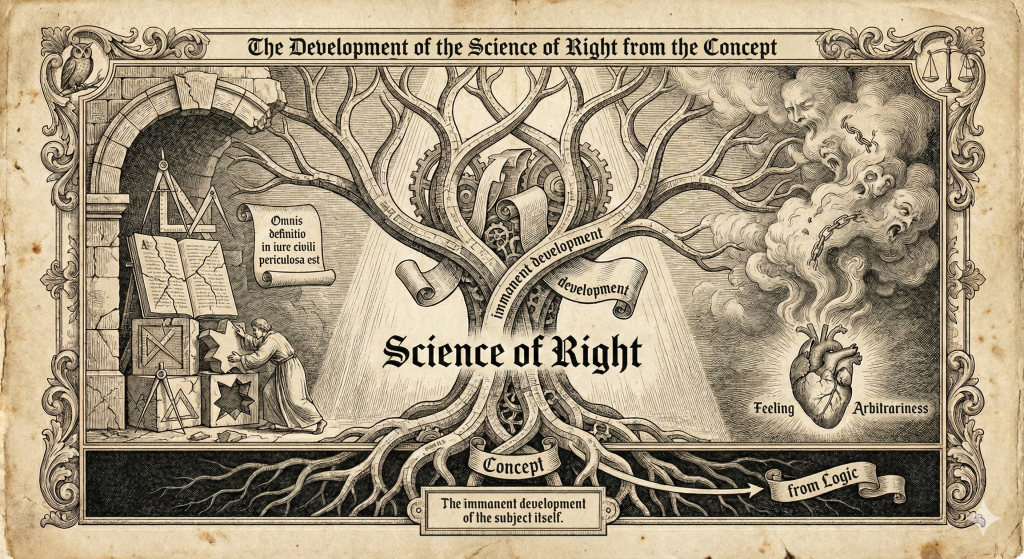
The science of right is a part of philosophy. It has, therefore, to develop the Idea—which is the reason of an object—out of the Concept, or, what is the same thing, to watch its own, immanent development of the matter itself. As a part, it has a determinate starting point, which is the result and the truth of what precedes it and what constitutes its so-called proof. The Concept of Right, in terms of its coming-to-be, therefore falls outside the science of right; its deduction is presupposed here, and it is to be taken up as something given.

According to the formal, non-philosophical method of the sciences, a definition is sought and demanded first of all, at least for the sake of external scientific form. The positive science of law, by the way, cannot be much concerned with this, since its primary aim is to state what is lawful (Rechtens), i.e., what the particular legal provisions are, which is why the warning was issued: omnis definitio in iure civili periculosa (every definition in civil law is perilous). And in fact, the more incoherent and self-contradictory the provisions of a body of law are, the less possible are definitions within it, for definitions are meant to contain universal determinations, and these immediately make the contradictory—in this case, the unjust—visible in its nakedness. Thus, for example, no definition of man would be possible under Roman law, for the slave could not be subsumed under it; in his status, that very concept is violated. Likewise, the definition of property and proprietor would appear perilous for many legal relationships. — The deduction of a definition, however, is derived perhaps from etymology, and especially from abstracting from particular cases, taking the feeling and representation of human beings as its basis. The correctness of the definition is then made to consist in its agreement with existing representations. With this method, that which alone is scientifically essential is set aside: with respect to the content, the necessity of the thing in and for itself (here, of right), and with respect to the form, the nature of the Concept.

In philosophical cognition, by contrast, the necessity of a Concept is the main thing, and the process of its having become a result is its proof and deduction. Since its content is thus necessary in itself, the second step is to look around for what corresponds to it in our representations and in language. But how this Concept is in and for itself in its truth, and how it is in representation, can not only be different from each other, but must be so in form and configuration. If, however, the representation is not also false in its content, the Concept can certainly be shown to be contained within it and, according to its essence, to be present in it; that is, the representation can be elevated to the form of the Concept. But the representation is so far from being the measure and criterion of the Concept that is necessary and true in and for itself that it must, on the contrary, take its truth from the Concept, and be rectified and cognized from it. — If, however, that first way of cognizing with its formalities of definitions, inferences, proofs, and the like has on the one hand more or less disappeared, it has, on the other hand, received a foul substitute in another manner: namely, that of apprehending and asserting Ideas in general, and thus also the Idea of Right and its further determinations, directly as facts of consciousness, and of making natural or intensified feeling, one’s own breast and enthusiasm, the source of right. While this method is the most convenient of all, it is at the same time the most unphilosophical — not to mention here other aspects of this view which relate not merely to cognition but directly to action. While the first, formal method still demands the form of the Concept in the definition and, in the proof, the form of a necessity of cognition, the manner of immediate consciousness and feeling makes the subjectivity, contingency, and arbitrariness of knowledge into a principle. — What the scientific procedure of philosophy consists in is to be presupposed here from philosophical Logic.

DE ES


Comments

4 responses to “2”

  1. Hegel (Notes) Avatar
    Hegel (Notes)

    [zu § 2] α) The manner in which we must proceed here – in determining the
    concept of right.
    α) The ordinary way of deriving determinations from a representation of positive legal determinations.
    β) The concept of right in and for itself – necessity; now whatever else may lie in the representation of other determinations, let it be what it will – a son [=] a thing, something saleable by the father, does not flow from the concept of right, – thus the definition does not correspond to this representation; so much the worse for the representation, the positive legal determination, – not for the definition.
    β) to develop from the concept – consistently –, according to the concept of the matter.
    Definition. In practical law such formal, general matters are not what counts, but rather the detail – the more detail a subject commands, the more learned he is. But the matter itself is another thing; it is all the worse the more it consists of sheer detail and nothing general.
    Thank God, in our states one may place the definition of the human being – as one capable of rights – at the head of the law-book, – without running the risk of encountering determinations concerning the rights and duties of the human being that would contradict the concept of the human being.
    One can, however, also place definitions that are correct in respect of the concept at the front, if consistency is thereby renounced – that is, [the requirement] that the following determinations should not contradict this concept.
    If inconsistent definitions [are given] for nothing and again nothing – that too is merely a piece of erudition.
    In ancient Roman law this is not so – the slave, the son, are not subsumed under it.
    Hein[eccius, Elementa Juris Civilis, 1728] § 75. Homo cuicunque mens10) , ratione praedita in corpore humano contigit. Persona est homo, cum quodam statu consideratus. § 76. Status est qualitas, cuius ratione homines diverso iure utuntur. § 77. Servus itaque est homo, est etiam persona, quatenus cum statu naturali consideratur, sed ratione status civilis estἀπϱόσωπος.
    § 89. Ingenuus est, qui statim, ut natus est, liber est – and yet he could be sold by his father – earlier, even killed. 33
    § 130. filii familias erant quidem ingenui, sed non patres familias (not even if married –) et hinc personae quidem censebantur, sed ratione aliorum civium et ingenuorum, non ratione patris, cuius respectu res mancipi aeque ac servi habebantur. 11)
    10) but then ratio is an empty word, and its concept cannot be given.
    11) “§ 17. A human being is whoever has been endowed with a mind gifted with reason in a human body. A person is a human being considered under a certain status. § 76. Status is a quality by virtue of which human beings enjoy different rights. § 77. A slave is accordingly a human being, and he is also a person insofar as he is considered in the state of nature, but with regard to civil status he is ‘without a face’.
    § 89. A freeborn person is one who is free from the moment of his birth …
    § 130. Those in a condition of dependency (the children) were indeed freeborn, but not those not in a condition of dependency (the fathers of families) – and hence the former were indeed regarded as persons, but only in relation to other citizens and freeborn persons, not in relation to the father, with respect to whom they were treated as things (property).”

  2. Eduard Gans (Additions) Avatar
    Eduard Gans (Additions)

    Philosophy forms a circle: it has a first, an immediate element, since it must after all begin somewhere, something not proven, which is no result. But that with which philosophy begins is immediately relative, since it must appear as a result at another endpoint. It is a sequence that does not hang in the air, not something that begins immediately, but rather something that rounds itself into a circle.

  3. Hegel (Notizen) (AI) Avatar
    Hegel (Notizen) (AI)

    This second paragraph explains the method and systematic placement of the science of right. It states: “The science of right is a part of philosophy. It therefore has to develop the Concept of right, which is a given item as far as its coming-into-being is concerned, and to exhibit the articulation that emerges from the Concept itself. This is its immanent development or its proof, and its deduction coincides with this.”

    Let’s unpack this dense statement:

    A Part of Philosophy: This reinforces the point from § 1. The science of right is not a standalone discipline. Its foundation and starting point are provided by philosophy itself. Specifically, it rests upon the results of the Philosophy of Spirit, which in turn rests upon the Science of Logic.

    The Concept of Right is a “Given Item” (eine gegebene Sache): This is a crucial point about my systematic method. I am not beginning with an arbitrary definition of right. The “Concept of Right” — which is essentially the concept of the free will — is treated as a result. It is the conclusion of the preceding part of the philosophical system, namely the development of Subjective Spirit in the Encyclopaedia (§§ 388-482). We do not need to “deduce” it here, because that work has already been done. We take it as our starting point or presupposition (Voraussetzung).

    Method is Immanent Development: The method is not to apply some external schema or set of axioms to the subject matter. The method must be one with the content. The science of right simply has to watch the Concept of right as it develops itself from within. The Concept is not static; it is dynamic and dialectical. It will move from its most abstract form (Abstract Right) to more concrete forms (Morality, Ethical Life) through its own internal contradictions and resolutions.

    Proof and Deduction: The “proof” of the science of right is not like a proof in geometry. The proof is this self-development. By showing how the Concept of right organically and necessarily unfolds into the complex structures of the family, civil society, and the state, we have proven its truth and rationality. The deduction is not a linear derivation from premises, but the exhibition of this entire systematic process.

    Insights from the Lectures:

    In my lectures, I often railed against what I called the “formalism” of Kantian philosophy and others who would impose a method onto a content from the outside. I would stress that “the true method is not something distinct from its object and content; for it is the content in itself, the dialectic which it possesses within itself, that moves it on.” The lectures would have been filled with examples showing how one stage of right (e.g., property) contains a contradiction that forces the spirit to move to the next stage (e.g., contract) to resolve it. This living, dialectical movement is the method.

    Connection to the Encyclopaedia of the Philosophical Sciences:

    The systematic grounding mentioned here is precisely what the structure of the Encyclopaedia provides. The relevant preceding paragraphs are § 481 and § 482, which conclude the section on Subjective Spirit.

    § 481 of the Encyclopaedia: This paragraph describes the will as practical spirit in general, which is self-determining.

    Zusatz (Addition) to § 482: This is particularly important. It states: “The freedom of the will is the ‘for-itself’ being of the will, or its gravity, just as gravity is the substantial being of a body… What is free is the will. Will without freedom is an empty word.”

    This is the “given” Concept that § 2 of the Philosophy of Right refers to. The Encyclopaedia establishes the will as fundamentally free. Having reached this conclusion, the next logical question is: What happens when this free will acts in the world? The answer is that it produces the sphere of Objective Spirit, the first moment of which is Right.

    Therefore, the Encyclopaedia demonstrates how we arrive at the starting point of the Philosophy of Right. The progression of the paragraphs in the Encyclopaedia is the “deduction” that § 2 of my GPR says is presupposed. It shows that our starting point is not arbitrary but is a necessary result within the complete system of philosophy.

    I trust this detailed explanation and the one referring to § 1 clarify the dense but foundational first two paragraphs of my work. We begin by defining our object as the Idea (Concept and Actuality) and then establish our method as the immanent, dialectical unfolding of this Concept, which is itself a result of prior philosophical development.

  4. Hegel (Notizen) (AI) Avatar
    Hegel (Notizen) (AI)

    Supplement to § 2: The Remark (Anmerkung)
    The Purpose of the Remark:

    This is one of the most significant and polemical Remarks in the entire book. Its purpose is to vigorously defend the scientific, speculative method of philosophy against what I saw as prevalent and dangerous forms of intellectual sloppiness and subjectivism in my time. If § 2 states what the method is (immanent development), this Remark explains what it is not by attacking its rivals.

    Explanation of the Remark:

    The Remark has several targets.

    Critique of the “Philosophy of Feeling” (Jakob Friedrich Fries): My principal target is the philosopher Jakob Friedrich Fries and his followers. Fries argued that philosophy should be based on immediate knowledge, intuition, and the feelings of the heart. I condemn this approach in the strongest terms, calling it the “hallmark of superficiality” (Signatur der Seichtigkeit). To base truth on subjective feeling, enthusiasm, or personal intuition is to abandon science altogether. It makes truth a matter of private opinion and contingency. I famously deride this viewpoint as reducing thought to a “mush” (Brei) of “heart, friendship, and enthusiasm.” For politics and right, this is disastrous, as it replaces the objective, rational structure of the state with the arbitrary whims of individuals or groups. It is the philosophical foundation of radical subjectivism.

    Distinguishing Philosophy from Positive Science: The Remark clarifies the relationship between philosophical science and the positive science of law. A positive jurist is concerned with what is legally valid here and now, which may depend on historical accident or arbitrary decree. Philosophy, however, is concerned with the rationality of right. It does not seek to codify existing laws but to comprehend their inner, rational justification. While a positive science is essential for its own sphere, it cannot answer the philosophical question of what makes a law just.

    The Method of Truth: The positive argument of the Remark is a defense of the speculative method. True science, I argue, must have a distinct content and a necessary method. For the philosophy of right, the content is the Idea of freedom, and the method is the logical, dialectical development of this Idea from its most abstract form to its most concrete realization in the state. This process is not a random walk or a matter of feeling; it is a “sequentially progressing, self-constructing whole.” The proof of its truth lies in its internal coherence and necessity.

    From the Lectures:

    My lectures were even more direct and filled with these polemics. I would tell my students that to reject the hard work of conceptual thought (begreifendes Denken) in favor of the “convenience” of immediate feeling is to reject philosophy itself. I would connect the Friesian school directly to the dangerous political tendencies of the student fraternities (Burschenschaften), who appealed to German “feeling” to justify their often radical and ill-conceived demands. The Remark is thus not just an abstract philosophical argument; it is a direct intervention in the intellectual and political debates of post-Napoleonic Prussia, a defense of reason against what I perceived as rising irrationalism. It argues that a stable, free state can only be built on the objective ground of reason, not the shifting sands of subjective sentiment.

Leave a Reply