
Right is positive in general: a) through the form of having validity within a state; this legal authority is the principle for the knowledge of right, the subject of positive jurisprudence. b) In terms of content, this right receives a positive element α) through the particular national character of a people, the stage of its historical development, and the interconnectedness of all those relations belonging to natural necessity; β) through the necessity that a system of legal right must contain the application of the universal concept to the particular nature of objects and cases as given from the outside—an application which is no longer speculative thinking and the development of the concept, but the subsumption by the understanding; γ) through the final determinations required for decision-making in actuality.
|7| If the feeling of the heart, inclination, and caprice are set against positive right and the laws, philosophy at least cannot be the authority that recognizes such claims. — That force and tyranny can be an element of positive right is accidental to it and does not affect its nature. Later, in § 211–214, the point will be shown where right must become positive. |8| The determinations that will emerge there are mentioned here only to designate the boundary of philosophical right and to immediately dismiss any notion or even demand that its systematic development should result in a positive legal code—that is, one such as an actual state requires. — To pervert the fact that natural right or philosophical right is distinct from positive right into the claim that they are opposed and conflicting would be a great misunderstanding; the former relates to the latter rather as Institutes to Pandects. — Regarding the historical element in positive right mentioned first in the paragraph, Montesquieu indicated the true historical view and the genuinely philosophical standpoint: that legislation in general and its particular determinations should not be considered in isolation and abstraction, but rather as a dependent moment of a totality, in connection with all the other determinations that constitute the character of a nation and an age; in this connection, they receive their true meaning as well as their justification. — To consider the emergence and development of legal determinations as they appear in time—this purely historical effort—as well as the recognition of their logical consistency, which results from comparing them with already existing legal relations, has its merit and value within its own sphere and stands outside the relationship with philosophical consideration; provided, that is, that development from historical grounds does not confuse itself with development from the concept, and that historical explanation and justification are not extended to the significance of a justification that is valid in and for itself. This distinction, which is very important and to be firmly maintained, is at the same time very evident: a legal determination can be shown to be perfectly grounded and consistent based on circumstances and existing legal institutions, and yet be inherently wrongful and irrational, like a multitude of determinations in Roman private law that flowed quite consistently from such institutions as Roman paternal power or Roman marriage. But even if legal determinations are rightful and rational, it is one thing to demonstrate this of them—which can only truly happen through the concept—and quite another to present the historical manner of their emergence, the circumstances, cases, needs, and events that brought about their establishment. Such a demonstration and (pragmatic) cognition from near or remote historical causes is frequently called explanation or, even better, comprehension, in the belief that through this demonstration of the historical, everything, or rather the essential matter at stake, has been achieved in order to comprehend the law or legal institution; whereas in fact the truly essential thing, the concept of the matter, has not even been mentioned. — People also tend to speak of Roman or Germanic legal concepts, of concepts of right as they are defined in this or that legal code, whereas in fact these are not concepts at all, but only general legal determinations, propositions of the understanding, principles, laws, and the like. — By neglecting that distinction, one succeeds in shifting the standpoint and playing off the question of true justification into a justification based on circumstances, consistency from premises that may themselves be worthless, and so forth, and generally putting the relative in place of the absolute, the external appearance in place of the nature of the thing. It happens to historical justification, when it confuses external origin with origin from the concept, that it unconsciously does the opposite of what it intends. |9| If the origin of an institution under its specific circumstances proves to be perfectly expedient and necessary, and thus what the historical standpoint requires is achieved, then if this is to count as a general justification of the matter itself, the opposite follows: namely, that because such circumstances are no longer present, the institution has thereby rather lost its meaning and its right.1 Thus, if, for example, the preservation of monasteries is argued for on the basis of their merit in cultivating and populating wildernesses, in preserving learning through teaching and copying, etc., and this merit is regarded as the ground and determination for their continued existence, it follows from this instead that under entirely changed circumstances they have become, at least to that extent, superfluous and inexpedient. — Since historical significance—the historical demonstration and making-comprehensible of an origin—and the philosophical view of the same origin and concept of the matter are at home in different spheres, they can maintain an indifferent attitude toward each other. But since they do not always maintain this quiet position, even in scientific matters, I will mention something further concerning this contact, as it appears in Mr. [Gustav] Hugo’s Textbook of the History of Roman Law [1799], from which a further clarification of that manner of opposition may emerge. |10| Mr. Hugo states there (5th edition [1818], § 53) ‘that Cicero praises the Twelve Tables with a side-glance at the philosophers,’ ‘but the philosopher Favorinus treats them exactly as many a great philosopher since then has treated positive right.’ Mr. Hugo expresses in the same place the once-and-for-all ready-made reply to such treatment on the ground ‘that Favorinus understood the Twelve Tables as little as these philosophers understand positive right.’ — Regarding the reprimand of the philosopher Favorinus by the jurist Sextus Caecilius in Gellius, Noctes Atticae, XX, 1 [22 f.], it first expresses the lasting and true principle of the justification of what is, in terms of its content, merely positive. “Non ignoras,” Caecilius says very well to Favorinus, “legum opportunitates et medelas pro temporum moribus et pro rerum publicarum generibus, ac pro utilitatum praesentium rationibus, proque vitiorum, quibus medendum est, fervoribus, mutari ac flecti, neque uno statu consistere, quin, ut facies coeli et maris, ita rerum atque fortunae tempestatibus varientur. Quid salubrius visum est rogatione illa Stolonis etc. quid utilius plebiscito Voconio etc. quid tam necessarium existimatum est, quam lex Licinia etc.? Omnia tamen haec obliterata et operta sunt civitatis opulentia etc.” 2 These laws are positive insofar as they have their meaning and expediency in circumstances, and thus only a historical value in general; for this reason, they are also of a transitory nature. The wisdom of legislators and governments in what they have done for existing circumstances and established for temporal relations is a matter for itself and belongs to the appreciation of history, by which it will be more deeply recognized the more such an appreciation is supported by philosophical points of view. — But of the further justifications of the Twelve Tables against Favorinus, I want to cite one example, because Caecilius therein employs the immortal fraud of the method of the understanding and its reasoning: namely, to provide a good reason for a bad cause and to believe one has justified it thereby. |11| For the abominable law which gave the creditor, after the expiration of the time limits, the right to kill the debtor or sell him as a slave, or even, if there were several creditors, to cut pieces from him and thus divide him among themselves—and specifically in such a way that if one had cut off too much or too little, no legal prejudice should arise for him (a clause which would have benefited Shakespeare’s Shylock in the Merchant of Venice and would have been most gratefully accepted by him)—for this, Caecilius cites the good reason that trust and faith were thereby all the more secured and that, precisely because of the abominability of the law, it was never intended to be applied. His thoughtlessness misses not only the reflection that this very determination destroys that intention (the securing of trust and faith), but that he himself immediately afterward cites an example of the failure of the law concerning false testimony due to its excessive penalty. — What Mr. Hugo means by saying that Favorinus did not understand the law is not apparent; any schoolboy is capable of understanding it, and the aforementioned Shylock would have understood even the cited clause, so advantageous to him, best of all; — by understanding, Mr. Hugo must only mean that cultivation of the understanding which is satisfied with a good reason in the face of such a law. — Another failure to understand pointed out to Favorinus by Caecilius in the same place can, moreover, be admitted by a philosopher without turning red with shame: namely, that jumentum, which according to the law was to be provided for a sick person to bring him as a witness before the court (and not an arcera), was supposed to mean not just a horse but also a carriage or wagon. |12| Caecilius could draw from this legal determination a further proof of the excellence and precision of the ancient laws, namely that they even deigned to push the determination for the production of a sick witness in court not just to the difference between a horse and a wagon, but between wagon and wagon—one covered and upholstered, as Caecilius explains, and one that is not so comfortable. One would thus have the choice between the harshness of that law or the insignificance of such determinations—but to state the insignificance of such matters, and especially of the learned explanations of them, would be one of the greatest offenses against this and other types of erudition.
Mr. Hugo also comes to speak of rationality with regard to Roman law in the cited textbook; what I have encountered of it is as follows. After having said in the discussion of the period from the origin of the state to the Twelve Tables (§ 38 and 39) ‘that people (in Rome) had many needs and were forced to work, using draft and pack animals as helpers, just as they occur among us, that the ground was a variety of hills and valleys and the city lay on a hill, etc.’—references which perhaps were intended to fulfill the sense of Montesquieu, but through which one will hardly find his spirit captured—he now cites in § 40, to be sure, ‘that the legal condition was still very far from satisfying the highest demands of reason‘ (quite correct; Roman family law, slavery, etc., do not even satisfy very minor demands of reason), but in the following periods Mr. |13| Hugo forgets to specify in which, or if in any of them, Roman law satisfied the highest demands of reason. However, of the legal classics in the period of the highest development of Roman law as a science, it is said in § 289 ‘that it has long been noted that the legal classics were formed by philosophy’; but ‘few know (though through the many editions of Mr. |14| Hugo’s textbook, more now know it) that there is no class of writers who, in consistent reasoning from principles, so much deserve to be placed alongside mathematicians and—in quite a striking peculiarity of the development of concepts—the recent creator of metaphysics [Kant], as do the Roman jurists: the latter is proved by the remarkable circumstance that nowhere do so many trichotomies occur as among the legal classics and in Kant.’ — That consistency praised by Leibniz is certainly an essential quality of jurisprudence, as it is of mathematics and every other science of the understanding; but this consistency of the understanding has as yet nothing to do with the satisfaction of the demands of reason and with philosophical science. Besides, the inconsistency of the Roman jurists and praetors is rather to be regarded as one of their greatest virtues, through which they deviated from unjust and abominable institutions, but felt compelled to devise callide empty verbal distinctions (such as calling what was nonetheless an inheritance a Bonorum possessio) and even a silly evasion (and silliness is likewise an inconsistency) in order to save the letter of the Tables, as through the fictio, ὑπόκρισις, that a filia is a filius (Heineccius, Antiquitatum Romanarum… liber I [Frankfurt 1771], tit. II, § 24). — It is, however, comical to see the legal classics, because of some trichotomous classifications—especially according to the examples cited in note 5 there—placed alongside Kant and thus called something like a development of concepts.
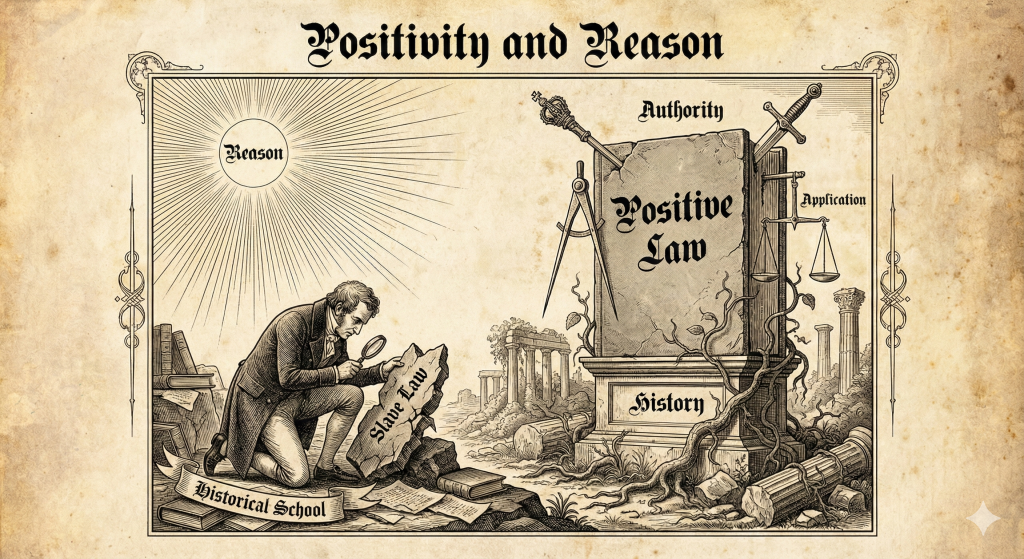
- Hegel’s Handexemplar. Engl[and] – Wisdom of ancestors ↩︎
- “You are well aware that the aids and remedies of the laws, if they are to be effective, must continually transform and change according to the customs of the age, the types of state constitution, the requirements and circumstances of the present, and the defects needing redress. They must not remain in a fixed state without being subject to change by the storms of events and chance, much like the appearance of the sky and the sea. What could have been more salutary than that legislative proposal of Stolo …, what more useful than the Voconian plebiscite …, what was considered as necessary as the Licinian law, …? And yet they have all fallen into oblivion and been overshadowed by the extraordinary prosperity of the state …” ↩︎



Leave a Reply
You must be logged in to post a comment.