4

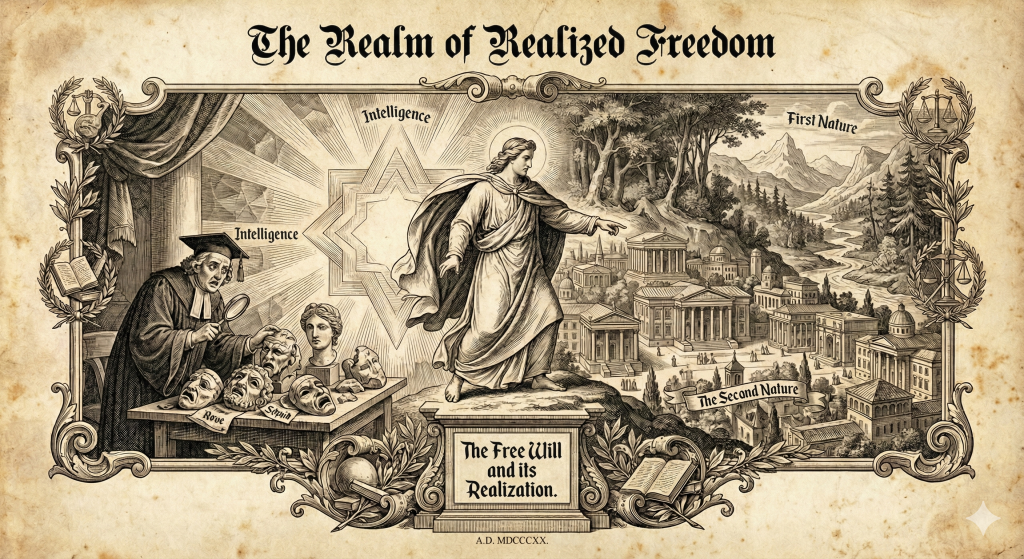
The ground of right is the realm of spirit in general; its more precise location and point of departure is the will, which is free, so that freedom constitutes its substance and determination, and the system of right is the realm of actualized freedom, the world of spirit produced from within itself as a second nature.

With regard to the freedom of the will, one may recall the former method of cognition. |15| Specifically, the representation of the will was presupposed, and an attempt was made to extract and establish a definition from it; then, in the manner of the former empirical psychology, the so-called proof that the will is free was conducted using various feelings and phenomena of ordinary consciousness—such as remorse, guilt, and the like—which were said to be explicable only on the basis of the free will. It is more convenient, however, to simply hold that freedom is given as a fact of consciousness and must be believed in. That the will is free and what will and freedom are—the deduction of this, as already noted (§ 2), can take place only within the coherence of the whole. The fundamental features of this premise—that spirit is initially intelligence and that the determinations through which it proceeds in its development follow the path from feeling through representation to thinking, in order to produce itself as will (which, as practical spirit in general, is the immediate truth of intelligence)—I have presented in my Encyclopedia of the Philosophical Sciences (Heidelberg 1817) § 363-399 1 and hope to be able to provide a further elaboration of them in the future. It is all the more a necessity for me to contribute my part toward a more thorough cognition of the nature of spirit because, as noted in § 367 Rem. therein, hardly any philosophical science is in such a neglected and poor state as the doctrine of spirit, which is commonly called psychology. — Regarding the moments of the concept of the will specified in this and the following paragraphs of the Introduction, which are the result of that premise, one can appeal to the self-consciousness of each individual for the purpose of forming a representation. |16| Everyone will first find within themselves the capacity to abstract from everything, whatever it may be, and likewise to determine themselves, to posit every content within themselves through themselves; and they will similarly find the example in their self-consciousness for the further determinations.
 

  1. Encyclopaedia, 3rd ed. § 443–482 ↩︎

DE ES


Comments

6 responses to “4”

  1. Hegel (Encyclopedia 1817) Avatar
    Hegel (Encyclopedia 1817)

    Encyclopedia of the Philosophical Sciences in Outline (1817), §§ 387, 400:

    § 387. Thinking, because it is the free concept, is free in respect of its content too; the determinacy of reason is the own determinacy of subjective intelligence, and as determinate it is its content and determinate being. Thinking subjectivity is thus actual; its determinations are purposes; it is free will.

    § 400. The objective spirit is the unity of the theoretical and the practical; free will, which is for itself as free will, in that the formalism, contingency, and subjectivity of its practical activity have sublated themselves. Through the sublation of this mediation it is the immediate singularity posited through itself, which, being just as much universal, is freedom itself. The will is only thus for itself, in that it thinks itself, is will as free intelligence.

  2. Hegel (Notes) Avatar
    Hegel (Notes)

    [zu § 4 Anm.]

    Intelligence
    Practical
    Theoretical
    posited as through me, a negative determination – to comport oneself practically against it, to alter it Existing, positively present – to observe, to let be, and – to cognize it as it is, to know it as universal

    Theoretical and practical
    α) not at all 2 faculties – practical representation
    αα) subjective purpose, what I will, ββ) that it be
    β) in the will – world, nature, necessity. – eternally built temple – eternally present – found.

  3. Hegel (Encyclopedia 1827) Avatar
    Hegel (Encyclopedia 1827)

    Encyclopedia of the Philosophical Sciences in Outline (1827), §§ 468, 482–484:

    § 468. Thinking, as the free concept, is thereby free in respect of its content too; the determinacy of reason is in itself the own determinacy of subjective intelligence, and the content means nothing other than precisely the determinacy which comprehending thought develops out of itself. Intelligence, knowing itself as that which determines a content which is just as much its own as it is determined as being, is will.

    § 482. The objective spirit is the unity of the theoretical and the practical; free will, which is for itself as free will, in that the formalism, contingency, and limitedness of its previous practical content have sublated themselves. Through the sublation of the mediation contained therein, it is the immediate singularity posited through itself, which, however, has likewise been purified into the universal determination, freedom itself. It has this universal determination only in that it thinks itself, is will as free intelligence.

    § 483. Spirit, which knows itself as free and wills this its own object, that is, has its essence as determination and purpose, is in general the rational will, or in itself the Idea, and therefore only the concept of absolute spirit. This abstract Idea is therefore only the side of the existence of reason, the individual will as knowledge of that determination of its own which constitutes its content and purpose, and whose merely formal activity it is.

    § 484. Because this will is only the Idea existing in itself and is thus finite, its objectivity has at first the following distinctions in it: α) that freedom is its inner determination and purpose, and β) that it relates to an external objectivity, which divides itself into the anthropological dimension of particular needs, into the external things of nature, which are for consciousness, and into the relation to other wills, which is at once a self-consciousness and a consciousness of them as different and particular.

  4. Hegel (Encyclopedia 1830) Avatar
    Hegel (Encyclopedia 1830)

    Encyclopedia of the Philosophical Sciences in Outline (1830), §§ 468, 481–484:

    § 468. Intelligence, which as theoretical appropriates the immediate determinacy, is, after completed taking possession, now in its property; through the last negation of immediacy it is implicitly posited that for it the content is determined by it. Thinking, as the free concept, is now free in respect of its content too. Intelligence, knowing itself as that which determines the content, a content which is just as much its own as it is determined as being, is will.

    § 481. The actual free will is the unity of theoretical and practical spirit; free will, which is for itself as free will, in that the formalism, the contingency and restrictedness of the previous practical content has sublated itself. Through the sublating of the mediation which was contained therein, it is the immediate individuality posited through itself, which however is equally purified into the universal determination, freedom itself. The will has this universal determination as its object and purpose in that it thinks itself, knows this its concept, is will as free intelligence.

    § 482. Spirit, which knows itself as free and wills itself as this its object, i.e. has its essence for its determination and purpose, is at first in general the rational will, or in itself the Idea, and therefore only the concept of absolute spirit. As abstract Idea it exists again only in the immediate will; it is the side of the determinate being of reason, the individual will as knowing of that its determination, which constitutes its content and purpose and of which it is only the formal activity. The Idea thus appears only in the will, which is a finite one, but is the activity of developing it and of positing its self-unfolding content as determinate being, which, as determinate being of the Idea, is actualityobjective spirit. Of no Idea is it so universally known that it is indeterminate, ambiguous and capable of the greatest misunderstandings, and therefore actually subject to them, as of the Idea of freedom, and none is current with so little consciousness. Since free spirit is actual spirit, misunderstandings about it are of the most immense practical consequences, just as nothing else has this invincible strength once individuals and peoples have grasped the abstract concept of freedom which is for itself into their representation, precisely because it is the very essence of spirit, and indeed as its actuality itself. Whole parts of the world, Africa and the Orient, have never had this Idea and do not have it yet; the Greeks and Romans, Plato and Aristotle, the Stoics too did not have it; on the contrary, they knew only that a human being is actually free through birth (as an Athenian, Spartan and so forth citizen) or through strength of character, culture, through philosophy (the wise man is free even as a slave and in chains). This Idea came into the world through Christianity, according to which the individual as such has an infinite worth, since it is the object and purpose of the love of God, destined to have its absolute relation to God as spirit, to have this spirit dwelling within it, i.e. that the human being is in itself destined to the highest freedom. If in religion as such the human being knows the relation to absolute spirit as its essence, it has further the divine spirit present also as entering into the sphere of worldly existence, as the substance of the state, of the family and so forth. These relations are formed by that spirit and constituted adequately to it, just as through such existence the disposition of ethical life becomes indwelling in the individual, and it is then actually free in this sphere of particular existence, of present feeling and willing. If the knowing of the Idea, i.e. of the knowing of human beings that their essence, purpose and object is freedom, is speculative, then this Idea itself as such is the actuality of human beings, not one which they therefore have, but [one which] they are. Christianity has made it in its adherents into their actuality, for example not to be a slave; if they were made slaves, if the decision about their property were placed in arbitrary pleasure and not in laws and courts, they would find the substance of their existence violated. This willing of freedom is no longer a drive demanding its satisfaction, but character, – spiritual consciousness become a being without drive. – But this freedom, which has the content and purpose of freedom, is itself at first only concept, principle of spirit and of the heart, and destined to develop itself into objectivity, into legal, ethical and religious as well as scientific actuality.

    § 483. Objective spirit is the absolute Idea, but existing only in itself; since it is thereby on the ground of finitude, its actual rationality retains the side of external appearance in it. The free will has immediately, at first, the distinctions in it that freedom is its inner determination and purpose and relates to an external, given objectivity, which divides itself into the anthropological dimension of particular needs, into the external things of nature, which are for consciousness, and into the relation of individual wills to individual wills, which are a self-consciousness of themselves as different and particular; this side constitutes the external material for the existence of the will.

    § 484. The purposive activity of this will, however, is to actualize its concept, freedom, in the externally objective side, so that it be a world determined by that concept, such that in it it is with itself, joined together with itself, and the concept is hereby completed into the Idea. Freedom, shaped into the actuality of a world, receives the form of necessity, whose substantial connection is the system of the determinations of freedom, and whose appearing connection is, as power, being-recognized, that is, its validity in consciousness.

  5. Eduard Gans (Additions) Avatar
    Eduard Gans (Additions)

    The freedom of the will is best explained by pointing to physical nature. For freedom is just as much a fundamental determination of the will as weight is a fundamental determination of bodies. If one says that matter is heavy, one might think that this predicate is merely contingent; but it is not, for nothing in matter is without weight: matter is rather weight itself. Weight constitutes body and is body. It is the same with freedom and the will, for the free is the will. Will without freedom is an empty word, just as freedom is actual only as will, as subject. As for the connection of the will with thinking, however, the following must be noted. Spirit is thinking in general, and man is distinguished from the animal by thinking. But one must not imagine that man is, on the one hand, a thinking being and, on the other, a willing being, and that he has thinking in one pocket and willing in the other, for this would be an empty representation. The difference between thinking and will is only that between theoretical and practical comportment, but they are not, say, two faculties; rather, the will is a particular mode of thinking: thinking as translating itself into existence, as the drive to give itself existence. This difference between thinking and will can be expressed as follows. In thinking an object, I turn it into a thought and strip it of its sensuous character; I make it into something that is essentially and immediately my own: for it is only in thinking that I am with myself; only comprehension is the piercing-through of the object, which no longer stands over against me and from which I have taken the property of its own that it held against me. As Adam says to Eve, you are flesh of my flesh and bone of my bone, so spirit says, this is spirit of my spirit, and the alienness has vanished. Every representation is a generalization, and generalization belongs to thinking. To make something universal means to think it. The I is thinking, and likewise the universal. When I say I, I thereby let drop every particularity – character, natural disposition, knowledge, age. The I is wholly empty, punctual, simple, yet active in this simplicity. The colorful painting of the world lies before me: I stand opposed to it, and in this very comportment I sublate the opposition, making this content my own. The I is at home in the world when it knows it, and still more so when it has comprehended it. So much for theoretical comportment. Practical comportment, by contrast, begins with thinking, with the I itself, and appears at first as opposed to it, because it immediately establishes a separation. In being practical, active – that is, in acting – I determine myself, and to determine myself means precisely to posit a difference. But these differences that I posit are, in turn, my own; the determinations belong to me, and the ends toward which I am driven are mine. Now even if I release these determinations and differences outward, that is, place them into the so-called external world, they nonetheless remain mine: they are what I have done, what I have made; they bear the trace of my spirit. If this, then, is the difference between theoretical and practical comportment, the relation between the two must now be stated. The theoretical is essentially contained within the practical: this runs counter to the notion that the two are separate, for one cannot have a will without intelligence. On the contrary, the will holds the theoretical within itself: the will determines itself, and this determination is at first something inward – what I will, I represent to myself; it is an object for me. The animal acts by instinct, is driven by something inward, and is in this way likewise practical, but it has no will, because it does not represent to itself what it desires. Just as little, however, can one comport oneself theoretically or think without will, for in thinking we are precisely active. The content of what is thought does indeed take on the form of being, but this being is something mediated, something posited through our activity. These differences are thus inseparable: they are one and the same, and in every activity – of thinking as much as of willing – both moments are to be found.

  6. Hegel (Simple) Avatar
    Hegel (Simple)

    § 4: The will as the basis of right

    Right is nothing natural. It does not grow like a tree. It comes from spirit. And the place where it begins is the will.

    The will is free. Freedom is not a property it just happens to have. Freedom is what the will is.

    That is why the whole of right is nothing but freedom that has become real. The laws, the family, the state: all this is freedom that has taken shape. Here spirit brings forth a world of its own. This world stands as firmly as nature. So we call it a second nature.

    How do we know that the will is free? In the past, people tried to show it in three ways.

    They took the will as already known and looked for a definition of it.

    They drew conclusions from feelings: Whoever feels remorse or feels guilty must have been free.

    Or they said in short: Freedom is a fact of our consciousness. You have to believe in it.

    The last way is the most convenient. None of them is a proof. Whoever infers freedom from remorse already assumes what he wants to show.

    We went a different way, in the doctrine of spirit. There we showed how the will comes about in the first place. Spirit begins as intelligence. It feels, it pictures things, it thinks. But thinking does not stay inside itself. It pushes outward; it wants to have an effect. Thinking that acts is the will.

    So the will is nothing but thinking. It is thinking that puts itself to work.

    And you can check this for yourself. You can set aside everything that surrounds you and everything that drives you. And you can give yourself a content and set yourself a goal. These two abilities are the root of right.

Leave a Reply