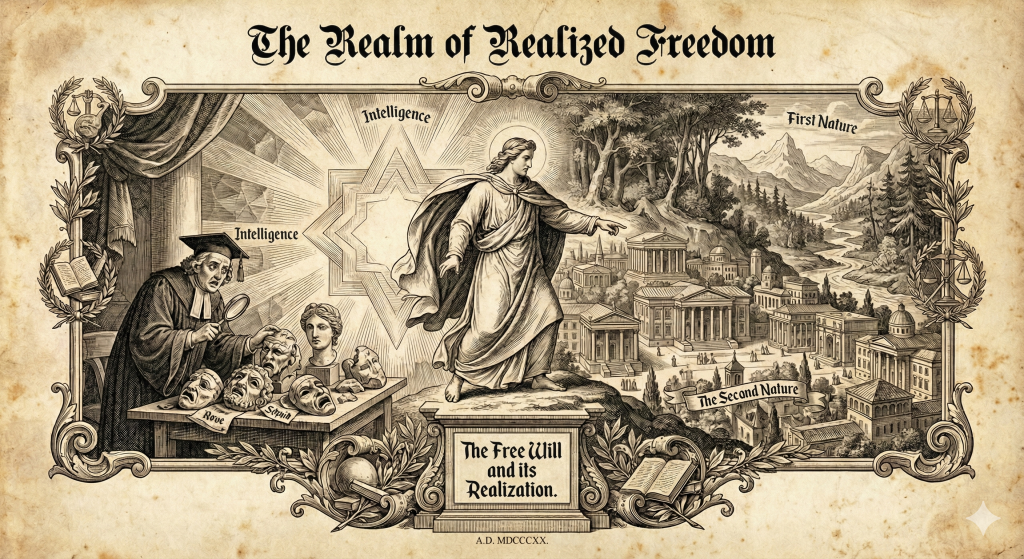
The ground of right is the realm of spirit in general; its more precise location and point of departure is the will, which is free, so that freedom constitutes its substance and determination, and the system of right is the realm of actualized freedom, the world of spirit produced from within itself as a second nature.
With regard to the freedom of the will, one may recall the former method of cognition. Specifically, the representation of the will was presupposed, and an attempt was made to extract and establish a definition from it; then, in the manner of the former empirical psychology, the so-called proof that the will is free was conducted using various feelings and phenomena of ordinary consciousness—such as remorse, guilt, and the like—which were said to be explicable only on the basis of the free will. It is more convenient, however, to simply hold that freedom is given as a fact of consciousness and must be believed in. That the will is free and what will and freedom are—the deduction of this, as already noted (§ 2), can take place only within the coherence of the whole. The fundamental features of this premise—that spirit is initially intelligence and that the determinations through which it proceeds in its development follow the path from feeling through representation to thinking, in order to produce itself as will (which, as practical spirit in general, is the immediate truth of intelligence)—I have presented in my Encyclopedia of the Philosophical Sciences (Heidelberg 1817) § 363-399 and hope to be able to provide a further elaboration of them in the future. It is all the more a necessity for me to contribute my part toward a more thorough cognition of the nature of spirit because, as noted in § 367 Rem. therein, hardly any philosophical science is in such a neglected and poor state as the doctrine of spirit, which is commonly called psychology. — Regarding the moments of the concept of the will specified in this and the following paragraphs of the Introduction, which are the result of that premise, one can appeal to the self-consciousness of each individual for the purpose of forming a representation. Everyone will first find within themselves the capacity to abstract from everything, whatever it may be, and likewise to determine themselves, to posit every content within themselves through themselves; and they will similarly find the example in their self-consciousness for the further determinations.