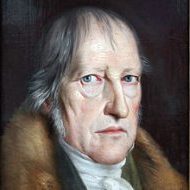
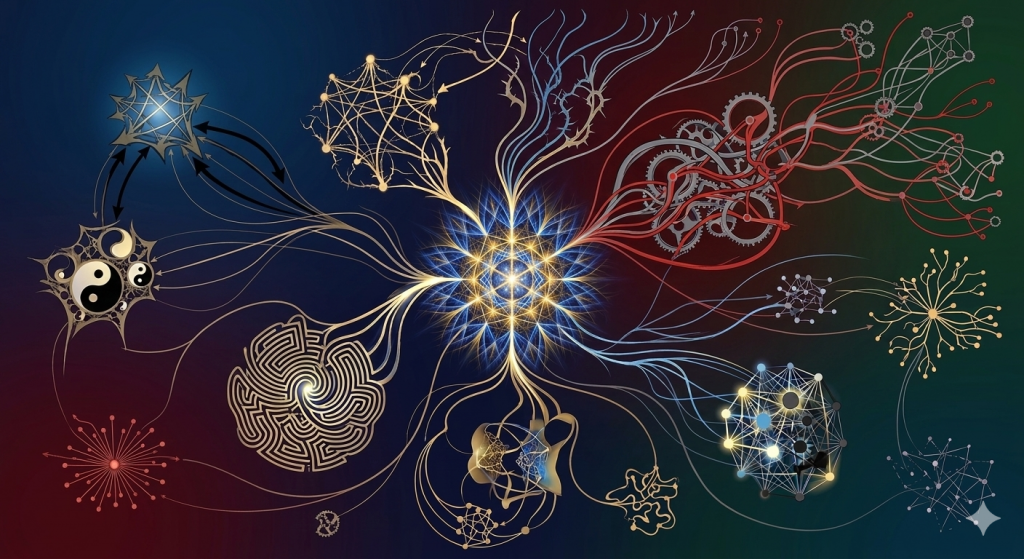
Georg Wilhelm Friedrich Hegel’s philosophy had a profound influence on the development of European and Western thought, as well as global thought in general. Numerous thinkers and scholars have engaged with his ideas or reacted to them in diverse ways. It is hardly possible to provide an exhaustive account of his reception history. What follows is a selection of philosophers, scientists, and movements that have engaged with Hegel’s philosophy and responded to it in a substantial manner:
- Reactions of Hegel’s Contemporaries & International Impact
- F.W.J. Schelling: He felt intellectually “disinherited” by Hegel, his former roommate and collaborator, believing his own system had been usurped. After Hegel’s death, Schelling went to Berlin to destroy the “Hegelian dragon seed.” He criticized Hegel’s philosophy as purely “negative” and conceptually empty, arguing that while it could logically derive the essence of things, it could not explain their actual, existential existence.
- J.G. Fichte: He initially perceived the rising Hegel merely as a “parrot” of Schelling. Later, he was repelled by Hegel’s “barbaric” style and the “obscurity” of his concepts, which he considered an unnecessary complication of thought.
- Friedrich Schleiermacher: He reacted with cool distance and academic resistance to Hegel’s dominance at the University of Berlin. He saw Hegel’s claim to fully dissolve religion into reason as a threat to the living, felt experience of faith, and sought to defend his own theology as a bulwark against Hegel’s “dictatorship of the notion.”
- J.W. von Goethe: He reacted with a mixture of reverent respect and amused bewilderment. He valued Hegel as a “friend of truth” but openly admitted that the Hegelian vocabulary often seemed like a secret language to him. Goethe attempted to use Hegelian thought for his own Theory of Colors but kept his distance from the abstract systematicity.
- Victor Cousin (France): He visited Hegel several times in Berlin and became the first major “importer” of Hegelianism to France. Cousin was fascinated by Hegel’s philosophy of history and attempted to translate his ideas into a French eclecticism, making Hegel an intellectual fashion in Paris as early as the 1820s.
- Johan Ludvig Heiberg (Denmark): He triggered a veritable “Hegel-mania” in Copenhagen after meeting Hegel personally in Germany. Heiberg became a passionate propagandist of the system in the North, which in turn provoked the fierce counter-reaction of Søren Kierkegaard.
- Wilhelm von Humboldt: As an educational reformer and linguist, he encountered Hegel with skepticism. While he admired Hegel’s intellectual power, he feared that his “mechanical” logic might stifle individual freedom and the living diversity of language and culture.
- “Old Hegelians” (Right Hegelians): While the Young Hegelians sought a break, the Old Hegelians strove to preserve and systematically continue the work in harmony with the state and religion. Outstanding among them is Eduard Gans, who edited the “Groundlines of the Philosophy of Right” after Hegel’s death and enriched it with valuable “Additions” (Zusätze) from lecture notes. Karl Rosenkranz (Hegel’s first biographer) and Karl Ludwig Michelet secured the editorial legacy and defended the system against contemporary attacks.
- “Young Hegelians” (Left Hegelians): A group of philosophers, including Ludwig Feuerbach, Bruno Bauer, and Max Stirner, who criticized and reinterpreted Hegel’s ideas in various ways. Feuerbach emphasized materialism and the critique of religion. Mikhail Bakunin belonged to the circle of Berlin Left Hegelians and radicalized Hegel’s dialectic of negation into a philosophy of action.
- Karl Marx, Friedrich Engels & Marxism: Marx transformed Hegel’s idealism into a dialectical materialism, leading to the development of communism. Marx famously cited Hegel as one of his favorite authors. Later, thinkers like Georg Lukács and V.I. Lenin engaged intensively with Hegelian dialectics for political practice.
- David Friedrich Strauß: His book The Life of Jesus (1835) used the Hegelian method to analyze the Gospels as “myths.” This triggered the greatest scandal of the century and led directly to the split between Right and Left Hegelians. Without Strauß, there would be no Feuerbach and no Marx.
- The Great Critics of the 19th Century: Arthur Schopenhauer (primacy of the will), Søren Kierkegaard (individual existence and faith), and Friedrich Nietzsche (will to power, anti-rationalism) often developed their systems in direct, sharp contrast to Hegelian “panlogism.”
- Phenomenology, Ontology & Existential Philosophy: Edmund Husserl and Martin Heidegger critically engaged with the Hegelian concept of spirit. Nicolai Hartmann (cf. Walter Jaeschke, Der Geist und sein Sein) sought new paths along Hegelian lines. Phenomenologists like Maurice Merleau-Ponty reacted to Hegel, while existentialists like Jean-Paul Sartre and Albert Camus emphasized individual freedom over the system.
- Vissarion Belinsky & Alexander Herzen: These two giants of Russian literary criticism and social philosophy made Hegel the foundation of the Russian Intelligentsia. Belinsky coined the famous (and often misunderstood) phrase regarding the “reconciliation with reality,” while Herzen described the dialectic as the “algebra of revolution”—a term that later became world-famous.
- T.H. Green & Bernard Bosanquet: They utilized Hegel’s concept of “Ethical Life” (Sittlichkeit) to transcend classical liberalism. They argued that the state should not merely be a “night-watchman” but must create the moral conditions for freedom, thus becoming the intellectual fathers of the modern British welfare state.
- French Hegel Renaissance & Psychoanalysis: Thinkers such as Jean Wahl, Alexandre Kojève, and Jean Hyppolite shaped the modern understanding of Hegel. Jacques Lacan integrated dialectics into psychoanalysis, and Simone de Beauvoir used it to establish modern feminism. Emmanuel Levinas formulated one of the most influential ethical critiques of Hegel. For Levinas, ethics, not logic, is “First Philosophy.” In more recent times, Slavoj Žižek has radically linked Hegelian logic with Lacanian theory.
- The Italian Reception: From the Risorgimento to Fascism
- Neapolitan Hegelianism: In the mid-19th century, Naples became a center for intensive Hegelian study. Bertrando Spaventa and Francesco De Sanctis saw in Hegel’s philosophy the spiritual foundation for the unification of Italy. Spaventa sought to prove that German idealism actually had Italian roots (e.g., in Bruno or Campanella) and used Hegel to justify a modern, secular state against the influence of the Church.
- Benedetto Croce: He is arguably the most influential Italian philosopher of the 20th century. In his famous work “What is Living and What is Dead of the Philosophy of Hegel” (1906), he subjected the system to a critical revision. He rescued Hegelian dialectics for historiography and aesthetics but rejected the philosophy of nature and rigid systematic constraints.
- Giovanni Gentile: He radicalized Hegelian idealism into so-called “Actualism” (the act of thinking as the only reality). Gentile became the “philosopher of Fascism” and utilized Hegel’s theory of the state (the state as absolute ethical substance) to provide the ideological basis for the totalitarian state under Mussolini—a highly controversial and consequential interpretation of the Philosophy of Right.
- Antonio Gramsci: The Marxist theorist engaged intensively in his Prison Notebooks with the Hegelian distinction between “civil society” and the “state.” His theory of cultural hegemony is unthinkable without Hegelian dialectics.
- Philosophy of Right, Sociology, and the State: Alongside the “Ritter School” (Joachim Ritter, Hermann Lübbe, Odo Marquard), which rehabilitated Hegel as the philosopher of freedom and civil society, stand thinkers like Leo Strauss and Carl Schmitt, whose understanding of the state and the political was significantly based on Hegel’s concept of “objective spirit.” Legal scholars such as Julius Binder and Karl Larenz also made Hegel fruitful for legal methodology.
- Humanities & Hermeneutics: Wilhelm Dilthey founded modern humanities (Geisteswissenschaften) by drawing on Hegel. Hans-Georg Gadamer continued this in his universal hermeneutics (“Truth and Method”), conceiving understanding as a historical, dialectical process and a “fusion of horizons” in the Hegelian sense.
- Hegel in Asia: China and Japan
- Maoism and Dialectics (China): Via Marx and Lenin, Hegel became the architectural foundation of modern China. Mao Zedong’s theory of contradiction is unthinkable without Hegelian dialectics. To this day, Hegel belongs to the mandatory canon at Chinese universities, where he is often studied far more intensively than in contemporary Europe.
- He Lin and “New Confucianism”: The philosopher He Lin (1902–1992), the most important Chinese translator of Hegel, attempted a bold synthesis, seeking to modernize Confucianism through Hegelian systematization. For him, Hegel was the tool to lead traditional Chinese ethics into the modern age.
- The Kyoto School (Japan): In Japan, the so-called Kyoto School (esp. Nishida Kitaro and Tanabe Hajime) developed a profound engagement between Zen Buddhism and Hegelian logic. They utilized Hegel’s concepts of “Nothingness” and “Mediation” to establish a modern Eastern philosophy capable of standing as an equal to Western thought.
- Postcolonial Critique: Contemporary Asian thinkers critically engage with Hegel’s view of history, which often dismissed Asia as “pre-historical” or “stagnant.” This engagement has led to a global reassessment of the concept of “World History.”
- Hegel in Latin America: Liberation and Coloniality
- Philosophy of Liberation: The Argentine-Mexican philosopher Enrique Dussel engaged intensively with Hegel, simultaneously offering a radical critique. He accused Hegel of absolutizing Europe as the center of the world, yet utilized Hegelian dialectics to establish an “Ethics of Liberation” for the “Other” (the periphery, the poor, the colonized).
- Law and Constitution: In countries like Brazil and Argentina, Hegel had a strong influence on legal philosophy and state-building. Hegel’s idea of the state as organizing reason was used to create stable institutions following the wars of independence, often in the tension between liberalism and authoritarian tendencies.
- Pedagogy of the Oppressed: Although often associated more with Marx, Paulo Freire’s thought is fundamentally based on the Hegelian insight that the consciousness of the oppressed can only achieve freedom through the engagement with the reality of oppression (the labor of the bondsman).
- Hegel and Africa: Reversing the Perspective
- Overcoming Exclusion: African thinkers had to grapple with Hegel because he explicitly excluded Africa from the World Spirit in his Philosophy of History. Thinkers of the Négritude movement, such as Léopold Sédar Senghor, nevertheless utilized the dialectical method to demand a synthesis of African values and Western reason.
- Achille Mbembe: The influential Cameroonian theorist critically engages with Hegel in works like Critique of Black Reason. He demonstrates how Hegelian concepts of subjectivity and spirit were used to dehumanize the “Other,” yet ironically uses Hegelian rigor to deconstruct these very structures.
- Frantz Fanon: Fanon is the key for Africa. In Black Skin, White Masks, he showed that Hegelian recognition between lord and bondsman fails in the colonial context because the master does not perceive the slave as a human being at all. In doing so, he laid the foundation for an independent African phenomenology.
- Sociology & Social Theory: In sociology, traces of dialectics are found in Bruno Latour (Actor-Network Theory) and in the engagement with modern systems theories by Armin Nassehi.
- Critical Theory (Frankfurt School): Theodor W. Adorno and Herbert Marcuse maintained the critical edge of dialectics. The subsequent generation, led by Jürgen Habermas and Axel Honneth (who recently provided a complete “re-actualization” of the Philosophy of Right), continues the dialogue with Hegel into the present day. Christoph Menke (third generation) links Hegel’s philosophy of right and state with a radical aesthetic critique, exploring the inherent tensions between individual freedom and legal form.
- Pragmatism & Analytic Philosophy: The American tradition (Charles Peirce, John Dewey) reacted to Hegelian holism. Today’s “Pittsburgh School” (John McDowell and Robert Brandom) massively integrates Hegel into analytic philosophy of language.
- The North American Hegel Renaissance: Thinkers like Robert Pippin and Terry Pinkard established an influential “non-metaphysical” reading. They interpret Hegel not as a speculative cosmologist, but as a continuer of Kantian critical philosophy, centering the conditions of the possibility of meaning and the social dimension of reason.
Shlomo Avineri & the Israeli Reception: With his seminal work Hegel’s Theory of the Modern State, Avineri pioneered the rehabilitation of Hegel as a precursor of the modern constitutional state against totalitarian misinterpretations. Along with thinkers like Yirmiyahu Yovel, he shaped a reading that emphasizes Hegel’s relevance for modern state-building and Jewish intellectual history.
- Javad Tabatabai: Arguably the most influential political philosopher of modern Iran. He utilized Hegel (particularly the Philosophy of Right) to analyze the “decay” of political tradition in Islam and to seek paths toward an Iranian modernity.
- Poststructuralism & Feminism: Michel Foucault and Jacques Derrida worked through Hegelian “totality.” While Gilles Deleuze emphasized difference, Hélène Cixous, Judith Butler, and Seyla Benhabib utilize Hegels theory of recognition for emancipatory theories. Rosi Braidotti links these approaches with posthumanist inquiries.
- Global Hegel & Postcolonialism: Frantz Fanon, Cornel West, and Gayatri Spivak use Hegelian categories (especially lordship and bondage) to analyze colonial and global power structures. Francis Fukuyama made Hegel’s “End of History” geopolitically famous.
- Aesthetics & Visual Studies: In art history and visual theory, Hegel’s reflections on art remain significant to this day, for instance in the work of Victor Stoichita.
- Contemporary German Thought: Beyond the Frankfurt School, Hegel remains a central figure in German academia. Klaus Vieweg (Jena) has re-established Hegel as the preeminent “Philosopher of Freedom,” particularly through his work on the Philosophy of Right. Pirmin Stekeler-Weithofer provides a logical-pragmatic reconstruction, stripping Hegel of “spirit-metaphysics” to reveal a rigorous theory of discursive reason. Rahel Jaeggi utilizes Hegelian categories to analyze social “forms of life” and alienation. Ludwig Siep remains a key figure in applying the theory of recognition to modern practical philosophy, and cultural critic Byung-Chul Han draws on the Hegelian concept of “negativity” to critique contemporary society.
- Karl Popper and others attempted to “recognize” Hegel through highly “selective” reading—which essentially meant: through ignorance.
- And countless others (scholars, theologians, artists, politicians, etc.)…
One can think with Hegel or against him—but not without him. And that means one must return to the “source text,” to Hegel’s own writings. Secondary literature is not enough. “The significance of Hegel is […] so controversial not least because his work is partly not read at all, and partly cannot be read for various reasons. […] There is, however, hardly any philosophical work whose accessibility depends so much on a solid reading skill as that of Hegel.” (Pirmin Stekeler).
