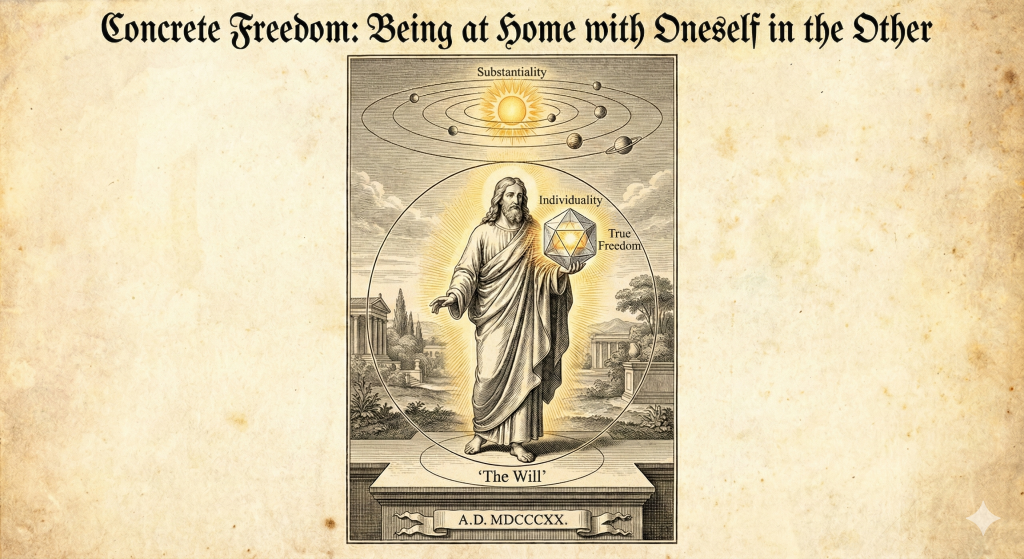
γ) The will is the unity of these two moments; — particularity reflected into itself and thereby brought back to universality; — individuality; the self-determination of the I, at once to posit itself as the negative of itself, namely as determinate and limited, and yet to remain with itself, i.e., in its identity with itself and its universality, and in this determination to join together only with itself. — The I determines itself insofar as it is the relation of negativity to itself; as this relation to itself, it is likewise indifferent to this determinacy, knows it as its own and as ideal, as a mere possibility by which it is not bound, but in which it only exists because it posits itself therein. — This is the freedom of the will, which constitutes its concept or substantiality, its gravity, just as gravity constitutes the substantiality of a body.
Every self-consciousness knows itself as universal — as the possibility of abstracting from everything determinate — and as particular, with a determinate object, content, or purpose. These two moments, however, are only abstractions; the concrete and the true (and all that is true is concrete) is universality, which has particularity as its opposite, but which through its reflection into itself is reconciled with the universal. — This unity is individuality1, not in its immediacy as a ‘one’ (as individuality is in representation), but according to its concept (Encycl. of the Philos. Sciences, § 112-114) — or rather, this individuality is essentially nothing other than the concept itself. Those first two moments—that the will can abstract from everything and that it is also determinate (through itself or something else)—are easily admitted and grasped, because they are in themselves untrue moments of the understanding; but the third, the true and speculative (and all that is true, insofar as it is comprehended, can only be thought speculatively), is that into which the understanding refuses to enter, for it always calls the concept precisely the incomprehensible. The proof and more detailed discussion of this innermost core of speculation—of infinity as negativity relating to itself, this ultimate source of all activity, life, and consciousness—belongs to Logic as purely speculative philosophy. — It can only be noted here that when one says: the will is universal, the will determines itself, one is already expressing the will as a presupposed subject or substrate; however, it is not something ready-made and universal prior to its determining and prior to the sublation and ideality of this determining, but is only will as this activity mediating itself within itself and returning into itself.
- [in Hegel’s hand: ] better: subjectivity ↩︎
