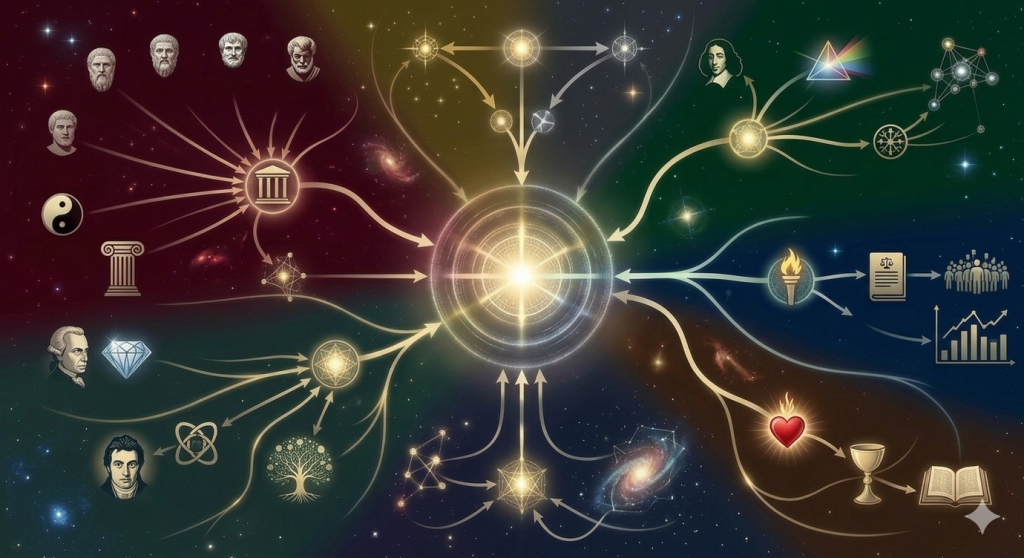
Parmenides (being): For Hegel he marks the true beginning of philosophy. From him comes the idea of the identity of thinking and being. Hegel takes over „pure being“ as the absolute point of departure, but criticizes its rigidity.
Heraclitus (becoming): The „motor“ of dialectic. He supplies the insight that everything is in flux and that unity subsists only through the strife of opposites. Hegel integrates becoming as the truth of being.
Plato (the Idea): He establishes objective idealism. Hegel takes over the primacy of the Idea, but brings it down out of the „beyond“ into concrete world history.
Aristotle (entelechy): Perhaps Hegel’s most important source for the understanding of development. Everything carries its end (telos) within itself and unfolds organically from germ to fruit.
2. Rationalism and Enlightenment: substance and order
Baruch de Spinoza (substance): He supplies totality. For Hegel, Spinozism is the necessary presupposition. He takes over the idea that everything is One, but wants to grasp this „substance“ as a living, acting „subject“.
Gottfried Wilhelm Leibniz (the monad): From him Hegel learns the organic unity of the whole, in which each part (the monad) mirrors the universe. Leibniz brings dynamism and individuality into rationalism.
3. The bridge-builders: crisis and form
Friedrich Heinrich Jacobi (contradiction): He warned that consistent rationalism ends in nihilism, and demanded „immediate knowing“. Hegel takes the warning against „dead knowledge“ seriously and tries to heal Jacobi’s „feeling“ through logical mediation.
Karl Leonhard Reinhold (systematicity): He drove the urge towards a philosophical system to its extreme. From him Hegel takes over the demand that philosophy must have a seamless, scientific form.
Jakob Böhme (the opposition within the divine): Hegel valued him as the „first German philosopher“. From him Hegel took over the idea of an inner dialectic of the divine, in which spirit attains self-revelation and reconciliation only through negation and pain.
4. German Idealism: subjectivity and deed
Immanuel Kant (the critique of reason): The trigger. Hegel takes over the „Copernican turn“ (the subject determines the world) and makes Kant’s „contradictions of reason“ (antinomies) the core principle of his logic.
Johann Gottlieb Fichte (the absolute I): He supplies the energy. All being is for Fichte an act of the I. Hegel takes over this activism, but widens it from the individual I to the „world spirit“.
Friedrich Wilhelm Joseph Schelling (the philosophy of identity): He integrates nature into spirit. From him comes the vision of the unity of subject and object, nature and spirit, which Hegel finally works out systematically.
5. The political foundation
Jean-Jacques Rousseau (the general will): Without him no philosophy of right. With the volonté générale Rousseau supplies the building block for Hegel’s understanding of freedom: it is not arbitrary choice but acting in accord with the rational whole.