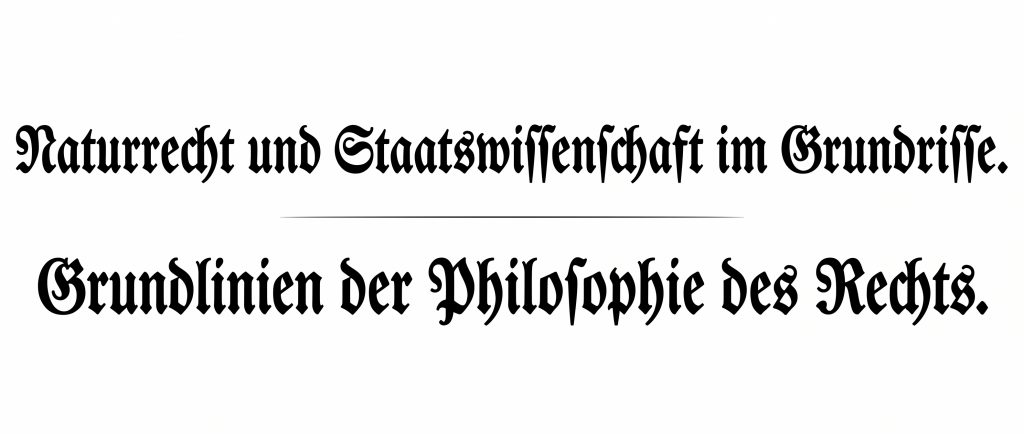
Grundlinien der Philosophie des Rechts oder Naturrecht und Staatswissenschaft im Grundrisse

For the use of his lectures
by
D. Georg Wilhelm Friedrich Hegel

Preface

[19th Paragraph]

To say a word more about instructing how the world ought to be, philosophy always comes too late anyway. |XXIV| As the thought of the world, it only appears in time after actuality has completed its process of formation and finished itself. This, which the concept teaches, is necessarily shown likewise by history: that only in the maturity of actuality does the ideal appear over against the real and builds for itself that same world, grasped in its substance, in the shape of an intellectual kingdom. When philosophy paints its gray in gray, then a form of life has grown old, and with gray in gray it cannot be rejuvenated, but only recognized; the owl of Minerva begins its flight only with the falling of dusk.

Skip directly to § 1 →

Pages: 1 2 3 4 5 6 7 8 9 10 11 12 13 14 15 16 17 18 19 20

DE ES

Comments

10 responses to “Preface”

  1. J.R. Ringier

    [to paragraph 5]

    Right for itself is the abstract concept. The state is the realization of right. Abstract right was often called natural right. In this way of looking at things the state is regarded not as the actualization of right but as a misfortune for right: a hard fate in which the natural right of man is restricted, taken advantage of and injured. Right is so regarded that that abstract right and the condition within it are regarded as a lost paradise, which must nevertheless remain the goal, to be restored by the state. Right, then, is regarded 1. as an abstract universal, 2. in its realization. Right is essentially the Idea, the concept – the universal –, but not [only] as subjective, rather also as actualization, as state. Right is what is holy on earth, inviolable. The holy, as it is inwardly, is untouchable; posited in actuality, it can be touched.

    The task of science is to determine the side of existence, so that right may come to its actuality, but first of all to know what true right is. This knowledge seems all the more necessary now, since all the world has taken possession of this subject. Most people have an opinion and firm convictions about it and make the claim on the actual world that right be actualized as it is in thought. This demand counts as something absolute because, as it is inwardly, it is something holy. It is chiefly philosophy that is to determine the concept of right and [is to determine] how actuality ought to be [in order] to correspond to the concept. The knowledge of right requires thoughts. The commonest view is that everyone, without speculative reflection, can draw the knowledge of right immediately out of his own breast and [his own] head. If, then, philosophy is to provide the concept, it must be an arsenal of reasons for contesting and improving what is actual. It is thus an ideal of actuality in which all wrong is set right. And, so it is thought, this ideal is all the more excellent the further removed it is from actuality. Many such absurd ideals have indeed been supplied. On the one hand, then, one demands of philosophy the knowledge of the concept of right, and that the concept has been a weapon1 for combating the concept; on the other hand it can be said that right and state belong to spirit. Spirit is their ground; its freedom is the foundation of the state, which is only the actuality of spirit. The state is as spirit knows itself: the subsistence of the state thus rests on developed or undeveloped thoughts; also the2 trust of those who belong to it. If, for example, all citizens were suddenly to change their representations of their constitution of right, the question would be: what remains? Nothing but a soulless framework that would already have fallen apart within itself. It cannot, therefore, be a matter of indifference to the state as a whole what representation its members chiefly3 have of right and its actuality.

    1) GW 26,1, p. 334: “Waffen gewähre” (provides weapons).
    2) GW 26,1, p. 334: “Auf dem” (on the).
    3) GW 26,1, p. 334: “Wirklichwerdung” (becoming actual).

  2. J.R. Ringier

    [to paragraph 11]

    Philosophy as science, then, has nothing to do with opinions. Opinion is only what is mine; with someone else it may be different. Knowledge in philosophy is absolute knowledge, knowledge of the absolute. Philosophy thus, so it seems, still makes demands on actuality from an absolute authority. It is not, admittedly, the science of the actual – in the sense that it takes up from the actual as such what is given, what right is. Positive jurisprudence has as its criterion what is valid. Since philosophy draws its determinations from the inner concept, it may seem to make an absolute pretension over against actuality. It may be that actuality agrees with it or not, because philosophy has the determination of being thought, concept; so it does indeed seem at first to stand over against actuality, in so far as a comparison with actuality necessarily arises for us.

    The first point, then, to be considered is what the purpose of the philosophy of right is and its relation to actuality, so that the nature and the goal of the science may emerge more clearly. We begin with Plato’s notorious passage (Republic 5). Unless either philosophers rule or kings philosophize, and ruling and philosophy [do not] coincide, there is no end of evil for the human race. The highest pretension of philosophy is expressed here. Because philosophy knows the true, and ruling rests on thought, on knowledge of the welfare of the state, philosophy would also have to be what leads. This must be considered more closely.

  3. J.R. Ringier

    [to paragraph 12]

    We must place ourselves at a still higher standpoint regarding the relation of philosophy and actuality. One presupposition of that passage in Plato is that philosophy knows the true – more precisely, in the form of the concept. If it comprehends the true, then the true comes from another, known representation and event1, not from feeling2. Philosophy does not have a monopoly on truth. It does indeed know the truth, but it is not the only3 shape of it. In more recent times it did come to the point of knowing: one cannot know the truth – a conviction that would rob man of the consciousness of the divine and of truth if it could take firmer root. The first assertion in Plato we thus accept with this closer determination; secondly, it contains the presupposition that this truth is only an ought, but opposed to actuality. Against this we must defend and assert the true Idea of philosophy. The true Idea is substantial, the inner concept itself – not an empty representation, but what is strongest, what alone holds power. It would be an empty, irreligious representation that the divine were not mighty enough to give itself existence, that the true were only beyond the blue sky or in subjective thought, merely within. To nature divinity is conceded, but it is thought that the Idea has lost God, is left to the opinion, arbitrariness, contingency of men. The Idea is simply what is omnipresent, absolute – not as an indifferent spectator, but an utterly all-powerful, animating presence, so that actuality is only the body, the Idea the soul, without which the body cannot exist at all. In recognizing the Idea in philosophy, we recognize the actual itself, that which is, not that which is not.

    If the Platonic republic were not something deficient within itself, it would necessarily have come to actuality. Those who infer from actuality the nullity of the Idea are therefore not so wrong, but they are right in this, that actuality is the mirror of the true. What is hidden from them is that the world can be grasped only in the Idea; as man looks at the world, so the world looks at him. Regarded with reason it is rational; to reflection it shows a distorted image. In the philosophy of right we consider something that is, not something that is not. In philosophy we consider the realm of spirit and at the same time the world of external nature; philosophy considers the realm of spirit and its actuality. As regards the content of the Platonic Idea, it did indeed express what [appears] to us as the4 Idea of actuality. He brings the principle of Greek ethical life to consciousness; this was the Greek spirit; what Plato grasped as truth was how it was in Greece. Everywhere the Platonic shape of ethical life meets us. Action and individual are particulars which concern externality and are subordinate to the one5 pervading spirit; they are only on its surface, and the spirit of this ethical life is the soul, the inner principle. The movement is on the surface; there it comes to blows, to the passions, which destroy something or bring it into existence – play of existences6. Spirit exists only under particular circumstances: here it must fight its way through. But this ethical life cannot remain in the development of the universe, in this beauty7 and solidity; they must step out into division. Plato felt the beginning of this division. In his time the moment of world history emerges. The further principle of higher division necessarily appeared within the higher Idea of ethical life only as a corruption, because in it it was not yet developed and returned to harmony. So it had a destructive effect, and so Plato knew it and sought to master it, in that he would not let a8 higher principle befall his state but [would] extirpate [it], [just] as the Spartans suppressed the passions9, forbade money, but only made avarice10 break out all the more treacherously within. The principle is that of individuality, of subjective consciousness; it is present in ethical life too, but still enveloped. Plato had already sensed it, but would not resolve it, rather extirpate it, by dissolving the image of the family and everything that follows consistently from it. For this reason he seemed not to have an actuality, but only to make it an ideal, something non-actual, because it was the form of the11 Greek spirit. The true is not what [is] as the12 living, present spirit. Therefore the state sets up an13 ideal.

    1) GW 26,1, p. 335: “Geschichte” (history).
    2) GW 26,1, p. 335: “ausgeschloßen” (excluded).
    3) MS: “eigentümliche” (peculiar).
    4) GW 26,1, p. 336: “allerdings was anderes als die” (indeed something other than the).
    5) GW 26,1, p. 336: “und dem innern durchgehenden Geist” (and to the inner pervading spirit).
    6) GW 26,1, p. 336: “Existenz bringen – Spize der Existenz” (bring into existence – summit of existence).
    7) MS: “Schöne” (the beautiful).
    8) MS: “auf”.
    9) MS: “zu unterdrücken” (to suppress).
    10) Uncertain reading.
    11) GW 26,1, p. 336: “weil es nicht Form des” (because it was not the form of the).
    12) GW 26,1, p. 336: “nicht was anderes als” (not something other than).
    13) GW 26,1, p. 337: “die Wißenschaft kein” (science [sets up] no).

  4. J.R. Ringier

    [to paragraph 13–15]

    It is spirit that philosophy knows. Hence every philosophy stands essentially in its time, knows what is in and for itself, the present, the eternally true, which is neither something future nor something past; but it is no abstraction, rather a shape, because the body1 is actual; a determinate mode, the mode of the present spirit, is the highest mode of spirit, of its concept, which it has grasped of itself, of its self-consciousness. This shape is indeed twofold: as it belongs 1. to philosophy and 2. to the external shape of existing actuality. In its actual existence spirit is this motley tapestry that has these and those crisscrossing purposes. Philosophy does not consider this shape, but the motley throng [that] is brought back to the simple thought, without purposes of individuality, disinterested, through the system of its simple life. In religion one says that the events of the world are instruments in God’s hand, i.e. that this hand brings everything forth. Otherwise than those individuals will, it carries out these purposes2, while they seek to carry out their own, and precisely in this acting.

    The true spirit, the substantial, is thus on the one hand the essentially universal principle, what in animals is the genus. In animals the genus acts: i.e. instinct, in which the genus makes itself known. Besides the fact that this inner nature itself [becomes] manifest in them, they are then also again individuals belonging to this genus. On the other side it is the individuals who make up the existing actuality of spirit. The universal of spirit fills them, and individuality too has its rights, makes its particular purposes for itself. The genus, however, is what [is] the universal3 in it. But the universal interests also count as something essential. The passions, which seek their satisfaction, are what activates the universal. The true in and for itself is inert, does not carry itself out. What is active is the subjective, the actualizing, which takes on4 the universal, the abstract. The actual world is the simple spectacle that the universal pervades everything, and the purpose of the individual is the willing of individuals as individuals, who are the active ones. This is necessary for the actualization of the Idea; otherwise5 the actualization would lack the forces6, the Idea, purposes, which first have their own rights. But secondly the universal makes itself invincible in it, accomplishes itself in it. When philosophy considers the true, then this side does not concern it7; it raises up only the simple, substantial. [It] leads the manifold back to a simplicity. If we look through the microscope at the outline of a delicate drawing, it will appear to us uneven and with irregular roughnesses. To the naked eye it is beautiful. Worldly consciousness is such a microscope, for which only particulars are present. The naked eye leads the tumult of actuality back to simple actuality, free of those particular interests. On the one hand, then, philosophy does not pursue its history8 beyond events, but considers their substantial nature. It is philosophy that reflects the subsistence of actuality. The realm of right, the realm of spirit – they know that only what is present in the universal consciousness, the spirit of a people, can exist. Philosophy would consider it absurd if one wanted to give a people institutions that do not bring themselves about, whose time has not come. It gives the assurance that what has its time necessarily happens.

    Spirit is the ground of right. No right goes above the right of the universal spirit. But it is not abstract thinking: what is rational is actual and conversely, but not in the individual and the particular, which can become confused. An individual always misses it, does not hit the right9 of reason. Rational consideration raises one above taking what is contradictory in individuals for something so important.

    1) GW 26,1, p. 337: “das Leben” (life).
    2) GW 26,1, p. 337: “wollen führt jener Zweke aus” (will, it carries out their purposes).
    3) GW 26,1, p. 337: “ist aber nur das Allgemeine” (is, however, only the universal).
    4) GW 26,1, p. 337: “benimmt. In dieses Subjektive gehört alles” (removes. To this subjective belongs everything).
    5) MS: “andererseits” (on the other hand).
    6) GW 26,1, p. 338: “nothwendig zur Verwirklichung der Idee andererseits fält darein die Verwirklichung der Zweke” (necessary for the actualization of the Idea; on the other hand the actualization of purposes falls within it).
    7) MS: “ihr”.
    8) GW 26,1, p. 338: “Geschäfte” (business).
    9) GW 26,1, p. 339: “Ein Einzelnes vorgefallenes imer stört das Recht der Vernunft nicht” (a single occurrence never disturbs the right of reason).

  5. J.R. Ringier

    [to paragraph 18]

    The purpose of the philosophy of right, then, is to know the basis, the inner core of the actual world – the systematic edifice of spirit, but in its simple mode, in the element of thought. Philosophy in this respect has the same relation to the state as the church; the object of both is the true, but in its simple spirit, in the1 form of its eternity. The divine, felt in this form, is in the world as actual spirit. Philosophy is nothing but the shaping of religion. The purpose is closer with regard to religion: religion has as its object the true in the form of its eternity. […]2

    1) GW 26,1, p. 339: “seiner einfachen Gestalt in der” (its simple shape, in the).
    2) In the manuscript the following leaves (up to p. 24 of the manuscript) are blank.

  6. Hegel (Notes)

    [to paragraph 5]

    [Loose sheet with lecture notes on the Preface, late Berlin years]

    α.) To know what is right, that — laws —
    β.) Laws are old, — few men immortalized by having been the lawgivers of their peoples
    tough — granite frameworks, features of the life of peoples —
    Given —
    They are, and no one knows whence —
    divine authority
    γ.) Later the question, what is in itself — rational —
    Study α) theoretically — i.e. in thinking —
    Rational right — i.e. thinking and necessary within itself, this in the field, in the region of thinking — absolute purpose
    Whether rational that to a king by birth
    What holier than the right of kings — religion, the Lord’s anointed
    Positive — What men themselves understand, right — and that they will it, that their will be in it —
    Historical — drive spirit forth, instinct-like, mole —

    Natural right against society and the state — artificial, arbitrariness —
    i.e. the concept does not reach so far, from outside; — nature, individual will
    venerated men divine
    Laws are
    α. Thought
    β.) Nature — governs the life of men
    γ.) Freedom — against it —
    Natural thing — individual — not against its genus —
    δ.) Positivity, possibility, One reason One right —
    if (?) opposition — being ought, — relation of willing —*
    ε.) Philosophy nowadays against all authority
    Not as philosophy of nature[:] to comprehend what is —
    there exists a theoretical interest
    but a practical one — partly to reconcile with the present, partly to judge
    *ε.) Theoretically One law
    Doubt about the being of laws
    Just many kinds
    αα) Being whence —
    . . . that of his spirit out of his spirit
    ββ) Only will

  7. D.F. Strauß

    [to paragraph 5]

    What is called natural right, it was formerly believed, must be derivable from the nature of man, and the right of the state was not in keeping with nature, something no longer natural. The interest of our time may especially invite us to take up this subject. These lectures1 are to be based on the textbook published in 1821.

    Some general remarks shall be put first. It is right in general that we mean to treat. What is right? The laws pronounce it, and only in a state is there right.

    From my right there arises in the other a duty, and conversely — thus the two concepts are immediate correlates. Whoever has no rights has no duties either. Whoever has duties must also have rights.

    When we want to know what right is, then, we are first directed to the laws.

    The laws are what is most solid, the oldest, the basic frameworks of the life of peoples, the granite features in the life of peoples, the most enduring; through the whole life of a people, under all change, the laws have lasted. The laws are also what is oldest; it belongs to the oldest memories of peoples that institutions and laws arose among them; they ascribe these introductions to gods and heroes, they emerge already with the formation of states, beyond it lies a mythical time, only with law and state does history begin.

    The peoples have also gratefully preserved the names of their lawgivers. Famous but few are the names of the lawgivers, and mostly even these are only collectors. So Confucius, Manus2, related to Manes and Minos. These men belong to the remotest antiquity, like Moses 1500 years before Christ, Solon 500 years before Christ, Numa somewhat earlier still.

    These legislations still endure in all their solidity; the Mosaic legislation still endures in part, or at least it has had the most important influence down to our times, Sunday, marriage laws etc. Roman legislation likewise still has a great, general influence. These lawgivers have rightly been immortalized, their they are still present in daily life. To few men has this honour fallen.

    Now if these laws are ascribed to men, they appear at first as something merely human, i.e. indifferent, transient. But the basic institutions of these laws are often older than these men, and they count as something venerable, existing in itself, divine; the gods are always named as the first originators. So Antigone calls the laws by which she acted eternal, divine.

    To that extent the laws appear like laws of nature, as something unchangeable against which human arbitrariness can do nothing. The laws of nature, they are, they hold; the course of the heavenly bodies, the changes of organic nature are something necessary. Abnormalities may well occur, but nothing can be taken away from the universal, and even in individual excrescences the universal law asserts itself.

    If we seek to know these given laws, we must seek to make our representation conform to what is there. So it is now also with the knowledge of what is right: the laws are there, and we have to acquire a theoretical knowledge of them. The laws and customs of the land are there and are valid. In the study of jurisprudence one thus has to acquire this knowledge of what is there, and this knowledge also has its practical sides3: we want to seek to put these laws into practice on ourselves and on others, to arrange ourselves and our actions according to them.

    1) GW 26,3, p. 1491: “Grundlage dieser Vorlesungen” (in place of the singular “Vorlesung”).
    2) GW 26,3, p. 1491: “Manu”.
    3) GW 26,3, p. 1492: “ihre praktische Seite” (its practical side).

  8. D.F. Strauß

    [to paragraph 7]

    Our whole treatise can be nothing other than a development of the determinations of freedom. First the immediate determinations are given which hang together with freedom: that freedom is the source of laws, whereby these laws in the first place have a peculiar form, namely that of being something posited. Expressions in other languages also point that way, νόμος from νέμειν, what is allotted, lex from legere, to gather. Here, then, there enters the opposition between a being-posited and a being.

    That The laws are human positings, and yet they are not to be something contingent, transient, but quite Ueexalted above mere positing, above this mere relativity. This is the first difference, that of form.

    The second hangs together with it; it concerns the content. This content belongs to the will, to the free will. Freedom is also the source of the content of what is posited. Here, then, the same difference enters into the free will.1

    1) GW 26,3, p. 1493: “Da tritt dann in dem freyen Willen derselbe Unterschied [ein], der Wille ist einerseits [ein] zufälliger, willkührlicher …” – there the sentence runs on without a paragraph break; the continuation stands here under § 15.

  9. D.F. Strauß

    [to paragraph 13]

    What is actual is rational. But not everything that exists is actual; what is bad is something broken and null within itself. What freedom is must be grasped; precisely thereby the theoretical spirit frees itself. What spirit does not comprehend stands over against it, is an other for it. Once it has comprehended it, it has the substance of the thing and is with itself in it. When I have the concept of the sun, I am not indeed in possession of its external existence but but of its substance.

    With this theoretical interest the practical one is linked: that precisely the concept is nowadays the standpoint of this time. Nothing that rests merely on authority is any longer held to be valid; the laws etc. are to legitimate themselves through the concept.

  10. D.F. Strauß

    [to paragraph 13]

    Much is recognized only outwardly, no longer inwardly. Right is to be drawn from reason. Against this thought no privilege helps any longer; all particular rights are called to account by the concept of right. This, one may say, is the work of men, and to the work of men one opposes divine right as the highest. But nowadays precisely divine right is what is most rejected.

    The disceptatio about divine right was pursued with particular vigour in England. The kings appealed to divine right; from it, they said, flowed the duty of obedience to them. But by it these kings understood their arbitrary will.

    The divine is also the name given to its falsification, the arbitrary and contingent. When men have sudden notions, this counts as something divine. In nature, too, the isolated counts as divine, like lightning, earthquakes, cholera. That is where men would rather see the finger of God than in nature the regular course of nature, as if nature were less divine than these isolated events. So we are to understand the opposition of divine and human here too, as if the rights drawn from reason were not divine.

    The essence of God becomes truly actual, to his honour, in man. The knowledge of good and evil in Adam is the awakening consciousness of freedom, through which man is no animal. God himself then says: behold, Adam is become as one of us, precisely through freedom. This, then, is the standpoint of our time.

Leave a Reply