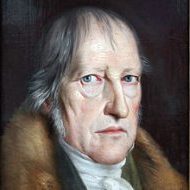
Author:
-
350
|349| To emerge in legal determinations and in objective institutions, proceeding from marriage and agriculture (see § 203 Anm.), is the absolute right of the Idea — whether the form of this its actualization appears as divine legislation and beneficence, or as violence and wrong; this right is the right of heroes to found states.
-
351
It is from this same determination that civilized nations regard and treat other nations which lag behind them in the substantial moments of the state — pastoral peoples regarding hunting peoples, agricultural peoples regarding both of these, and so on — as barbarians, with the consciousness of an unequal right, and regard their independence as…
-
352
The concrete Ideas, the spirits of nations, have their truth and destination in the concrete Idea as absolute universality — the world spirit, around whose throne they stand as the accomplishers of its actualization and as witnesses and ornaments of its splendor. |350| Since, as spirit, it is nothing but the movement of its activity…
-
353
In the first, as immediate revelation, spirit has as its principle the shape of substantial spirit as identity, in which individuality remains submerged in its essence and, for itself, without right. The second principle is the knowledge of this substantial spirit, such that it is the positive content and fulfillment, and being-for-self is its living…
-
354
According to these four principles, the world-historical realms are four in number: 1. the Oriental realm, 2. the Greek realm, 3. the Roman realm, 4. the Germanic realm.
-
355
|351| 1. The Oriental Realm This first realm is the substantial world-view, proceeding from the patriarchal natural whole and undivided within itself, in which secular government is theocracy, the ruler is also high priest or god, and constitution and legislation are at the same time religion, just as religious and moral commandments — or rather…
-
356
2. The Greek Realm This realm has that substantial unity of the finite and the infinite, but only as a mysterious foundation, thrust back into dull remembrance, into caves, and into images of tradition — a foundation which, born forth out of a self-differentiating spirit into individual spirituality and into the daylight of knowing, is…
-
357
3. The Roman Realm In this realm, the differentiation is consummated into an infinite laceration of ethical life, into the extremes of personal private self-consciousness, on the one hand, and abstract universality, on the other. The opposition, proceeding from the substantial outlook of an aristocracy set against the principle of free personality in democratic form,…
-
358
4. |354| The Germanic Realm Out of this loss of itself and of its world, and out of the infinite grief thereof — for which the Israelite people had been held in readiness — the spirit, driven back into itself, grasps, in the extreme of its absolute negativity, the turning point that is in and…
-
359
The inwardness of the principle — as the reconciliation and resolution of all opposition, still abstract and existing only in feeling, as faith, love, and hope — unfolds its content, raising it to actuality and to self-conscious rationality, into a temporal realm proceeding from the heart, from fidelity and the fellowship of free men; a…
-
360
|355| Since, in the hard struggle of these realms — which here stand in a difference that has attained its absolute opposition, and which are at the same time rooted in one unity and Idea — the spiritual degrades the existence of its heaven to an earthly here-and-now and to common worldliness, both in actuality…