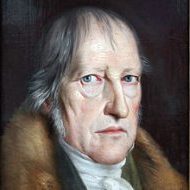
Author:
-
330
|337| B. External Constitutional Law External constitutional law proceeds from the relation between independent states; what is in and for itself [valid] within this relation therefore takes the form of an ought, because its being actual rests upon distinct sovereign wills.
-
331
A people, as a state, is spirit in its substantial rationality and immediate actuality, and is therefore the absolute power on earth; each state is accordingly, in relation to others, in sovereign independence. To be such for the other, that is, to be recognized by it, is its first, absolute entitlement. But this entitlement is…
-
332
The immediate actuality in which states stand toward one another particularizes itself into manifold relations, whose determination proceeds from the independent arbitrary will of both parties and thus has the formal nature of treaties in general. The subject matter of these treaties is, however, of infinitely less variety than in civil society, in which individuals…
-
333
|339| The principle of international law, as the universal right that is supposed to hold in and for itself between states, as distinct from the particular content of positive treaties, is that treaties, as that on which the obligations of states toward one another rest, are to be kept. But because the relation between them…
-
334
The dispute between states can therefore, in so far as their particular wills can reach no agreement, be decided only by war. |340| But which injuries — of a kind that can easily arise in great numbers within a state’s far-reaching sphere and its manifold relations through its members — are to count as a…
-
335
Moreover, the state, as something spiritual, cannot in general stop short at merely taking account of the actuality of the injury; rather, the representation of such an injury as a danger threatening from another state — with its rise and fall in greater or lesser probabilities, conjectures as to intentions, and so forth — is…
-
336
|341| Since, in their relation of independence, states stand over against one another as particular wills, and the validity of treaties rests precisely on this, while the particular will of the whole is, with regard to its content, its welfare in general, this welfare is the supreme law governing its conduct towards others — all…
-
337
The substantial welfare of the state is its welfare as a particular state in its determinate interest and condition, together with its equally distinctive external circumstances and its particular treaty relations: government is thus a particular wisdom, not universal providence (cf. § 324 Remark) — just as, in its relation to other states, the purpose…
-
338
|342| In the fact that states mutually recognize one another as such, there remains, even in war — that condition of rightlessness, violence, and contingency — a bond whereby they count for one another as beings in and for themselves, so that even in war itself, war is determined as something that ought to pass…
-
339
For the rest, the mutual conduct of states in war (e.g. the taking of prisoners), and what a state in peacetime grants to the members of another state by way of rights for private intercourse, and so forth, rests chiefly on the customs of nations, as the inner universality of conduct that maintains itself under…
-
340
Into the relation of states to one another — since within it they are particular — there falls the most agitated play of inner particularity: of passions, interests, purposes, of talents and virtues, of violence, wrong, and vice, as well as of external contingency, in the greatest dimensions of appearance — a play in which…
-
341
|344| C. World History The element in which the universal spirit has its determinate being — which in art is intuition and image, in religion feeling and representation, and in philosophy pure, free thought — is, in world history, spiritual actuality in its whole compass of inwardness and externality. World history is a court of…
-
342
World history, furthermore, is not the mere court of judgement of power — that is, the abstract and non-rational necessity of a blind fate — but, because spirit is in and for itself reason, and reason’s being-for-itself in spirit is knowledge, world history is the development, necessary solely out of the concept of its freedom,…
-
343
|345| The history of spirit is its deed, for spirit is only what it does, and its deed is to make itself — here, precisely as spirit — the object of its own consciousness, to comprehend itself by expounding itself to itself. This comprehension is its being and its principle, and the completion of an…
-
344
|346| The states, nations, and individuals engaged in this business of the world spirit arise each with its own particular determinate principle, which has its interpretation and actuality in their constitution and in the whole breadth of their condition; of this principle they are conscious and in whose interest they are absorbed, while at the…
-
345
Justice and virtue, wrongdoing, violence and vice, talents and their deeds, the small and the great passions, guilt and innocence, the splendor of individual and national life, independence, the good and ill fortune of states and of individuals, have their determinate meaning and worth within the sphere of conscious actuality, and there find their judgment…
-
346
Because history is the shaping of spirit in the form of happening — of immediate natural actuality — the stages of development are present as immediate natural principles; and these, being natural, subsist as a plurality external to one another, and thus further in such a way that to one nation falls one of these…
-
347
|347| The nation to which such a moment falls as its natural principle is entrusted with the execution of that principle in the course of the world spirit’s self-developing self-consciousness. In world history, this nation is, for this epoch — and it can (§ 346) make an epoch in it only once — the dominant…
-
348
|348| At the head of all actions, and thus also of world-historical actions, stand individuals as the subjectivities that give actuality to the substantial (§ 279 Anm., S. 289). As these living embodiments of the substantial deed of the world spirit, and thus immediately identical with it, that deed remains hidden from them themselves and…
-
349
A nation is not yet, as such, a state, and the transition of a family, horde, tribe, multitude, and so forth, into the condition of a state constitutes the formal realization of the Idea within it as such. Without this form, the nation — as the ethical substance which it is in itself — lacks…