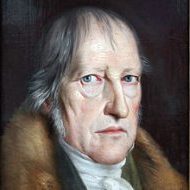
Author:
-
310
The guarantee of the qualities and disposition corresponding to this end — since independent wealth already claims its right in the first part of the Estates — is found, in the case of the second part, which proceeds from the mobile and variable element of civil society, chiefly in the disposition, skill, and knowledge of…
-
311
The deputation, as proceeding from civil society, further has the sense that the deputies be acquainted with its specific needs, obstacles, and particular interests, and belong to them themselves. |320| Since, in accordance with the nature of civil society, it proceeds from its various corporations (§ 308), and since the simple manner of this process…
-
312
Of the two sides contained in the Estates element (§ 305, § 308), each brings a particular modification into the deliberation; and since, moreover, the one moment has the distinctive function of mediation within this sphere, namely between existing extremes, a separate existence likewise results for it; the assembly of the Estates will thus divide…
-
313
Through this separation, not only does the maturity of the resolution obtain a greater security by means of a plurality of instances, and the contingency of a momentary mood, as well as the contingency which the decision might assume through a majority of votes, is removed; but above all the Estates element is less likely…
-
314
|322| Since the institution of the Estates is not intended to ensure that the affairs of the state are deliberated on and decided in the best possible way in themselves — in which respect they constitute merely an additional resource (§ 301) — but its distinguishing function consists in the fact that, through their shared…
-
315
The opening up of this opportunity for knowledge has the more general aspect that public opinion thereby first arrives at true thoughts and at insight into the condition and concept of the state and its affairs, and hence first attains a capacity to judge more rationally about these matters; it also comes to know and…
-
316
The formal, subjective freedom whereby individuals as such have and express their own judgment, opinion, and counsel concerning universal affairs has its appearance in that aggregate which is called public opinion. In it, the universal in and for itself — the substantial and true — is bound up with its opposite, the self-subsistent idiosyncratic and…
-
317
|323| Public opinion therefore contains within itself the eternal substantial principles of justice, the true content and result of the whole constitution, legislation, and the universal condition generally, in the form of common sense, as the ethical foundation running through everyone in the shape of prejudices, as well as the true needs and correct tendencies…
-
318
Public opinion therefore deserves to be as much esteemed as despised — despised with regard to its concrete consciousness and expression, esteemed with regard to its essential foundation, which, more or less obscured, merely shines through into that concrete form. |325| Since public opinion does not itself possess the standard of discrimination, nor the capacity…
-
319
The freedom of public communication — one of whose means, the press, has the advantage over the other, spoken discourse, of a far wider reach, but falls short of it in vivacity — and the satisfaction of that prickling urge to state one’s opinion and to have stated it, have their direct safeguard in the…
-
320
Subjectivity, which has its most external appearance as the dissolution of the existing life of the state in that opining and reasoning which seeks to assert its own contingency and thereby destroys itself, has its true actuality in its opposite: subjectivity as identical with the substantial will, which constitutes the concept of the power of…
-
321
|330| II. Sovereignty in Relation to Foreign States Sovereignty in the internal sphere (§ 278) is this ideality insofar as the moments of spirit and of its actuality, the state, are developed in their necessity and subsist as members of it. But spirit, as in freedom an infinitely negative relation to itself, is just as…
-
322
Individuality, as exclusive being-for-itself, appears as a relation to other states, each of which is independent in relation to the others. Since it is in this independence that the being-for-itself of actual spirit has its existence, independence is the first freedom and the highest honor of a people. |331| Those who speak of the wishes…
-
323
In existence, this negative relation of the state to itself thus appears as a relation of one state to another, and as if the negative were something external. The existence of this negative relation accordingly takes the form of an occurrence and an entanglement with contingent events coming from outside. But it is the state’s…
-
324
This determination, whereby the interest and the right of individuals are posited as a vanishing moment, is at the same time the positive [aspect] of their individuality — an individuality which is not contingent and mutable, but which is in and for itself. This relation, and the recognition of it, is accordingly their substantial duty…
-
325
|334| Since the sacrifice for the individuality of the state is the substantial relation of all, and thus a universal duty, it at the same time becomes, as the one side of ideality opposed to the reality of particular existence, itself a particular relation, to which a distinct estate, the estate of courage, is devoted.
-
326
Disputes between states can have as their object any particular aspect of their relationship; for such disputes, too, the particular part devoted to the defense of the state has its principal function. But insofar as the state as such, its independence, is placed in danger, duty calls upon all its citizens to its defense. When…
-
327
Courage is in itself a formal virtue, because it is the highest abstraction of freedom from all particular purposes, possessions, enjoyment, and life, yet [effects] this negation in an externally actual way; and because the renunciation, as accomplishment, is not in itself of a spiritual nature — its inner disposition may be this or that…
-
328
The content of courage as a disposition lies in the true, absolute ultimate end, the sovereignty of the state; the actuality of this ultimate end, as the work of courage, has as its means the surrender of personal actuality. This shape therefore contains the harshness of the highest oppositions: renunciation itself, yet as the existence…
-
329
The state has its outward direction in that it is an individual subject. Its relation to others therefore falls to the power of the crown, to which it accordingly belongs immediately and exclusively to command the armed forces, to maintain relations with other states through envoys and the like, and to conclude war and peace…