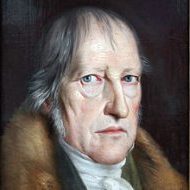
Author:
-
290
In the business of government, the division of labour (§ 198) likewise makes its appearance. The organization of the administrative bodies accordingly has the formal, but difficult, task that, from below, where civil life is concrete, this life should be governed in a concrete manner, while this business should nevertheless be divided into its abstract…
-
291
|301| The business of government is objective in nature, already decided in its substance for itself (§ 287), and is to be carried out and made actual by individuals. Between the two there is no immediate natural connection; individuals are therefore not determined for this by natural personality and birth. The objective moment for their…
-
292
The subjective side — namely, that this particular individual, out of the several individuals there necessarily and indeterminately are (since the objective element here does not lie in genius, as it does, for example, in art), among whom preference is not something absolutely determinable, is chosen and appointed to a given office and authorized to…
-
293
The particular business of the state which the monarchy hands over to the administrative bodies constitutes a part of the objective side of the sovereignty inherent in the monarch; the specific difference between these bodies is likewise given by the nature of the case, and just as the activity of these bodies is a fulfilment…
-
294
|302| The individual who is attached to an official vocation by the sovereign act (§ 292) is bound to the fulfilment of his duty — the substantial element of his relationship — as the condition of this attachment, in which, as a consequence of this substantial relationship, he finds the means and the secured satisfaction…
-
295
The security of the state and of the governed against the abuse of power on the part of the authorities and their civil servants lies, on the one hand, immediately in their hierarchy and responsibility, and, on the other hand, in the rights of communities and corporations, whereby the intrusion of subjective arbitrary will into…
-
296
|305| That dispassionateness, rectitude, and courtesy of conduct should become custom, however, depends partly on the direct ethical and intellectual formation which holds the spiritual balance against whatever mechanism and the like is contained in the acquisition of the so-called sciences of the objects of these spheres, the requisite practice in business, real work, and…
-
297
The members of the government and the civil servants make up the main part of the middle class, in which the educated intelligence and the legal consciousness of the mass of a people are found. That it should not assume the isolated position of an aristocracy, and that education and skill should not become a…
-
298
|306| c. Legislative Power Legislative power concerns the laws as such, in so far as they require further determination, and those internal affairs which, in their content, are wholly universal. This power is itself a part of the constitution, which is presupposed by it and, to that extent, lies in and for itself outside its…
-
299
These matters are more closely determined, in relation to individuals, according to two sides: α) what accrues to them through the state and which they are to enjoy, and β) what they have to render to it. Under the former are comprised the laws of private right in general, the rights of communities and corporations,…
-
300
In the legislative power as totality, the two other moments are, in the first place, operative: the monarchical moment, to which the supreme decision belongs; the governmental power, as the moment that deliberates in particular with the concrete knowledge and survey of the whole in its manifold sides and of the actual principles that have…
-
301
|309| The estates element has the determination that the universal concern should come to existence not only in itself but also for itself — that is, that the moment of subjective formal freedom, public consciousness as the empirical universality of the views and thoughts of the many, should attain existence in it. The expression the…
-
302
Considered as a mediating organ, the estates stand between the government in general, on the one hand, and the people resolved into its particular spheres and individuals, on the other. Their determination demands of them the sense and the disposition of the state and of the government just as much as of the interests of…
-
303
The universal estate — more specifically, the estate devoted to the service of government — has, immediately in its determination, the universal as the end of its essential activity; in the estates element of legislative power, the private estate attains a political significance and effectiveness. |313| It can, in this connection, appear neither as a…
-
304
The Estates element contains within its own determination the difference of the Estates already present in the earlier spheres. Its initially abstract position — namely that of the extreme of empirical universality as against the princely or monarchical principle in general, a position in which there lies only the possibility of agreement and hence equally…
-
305
|315| One of the Estates of civil society contains the principle that is in itself capable of being constituted for this political relation, namely, the Estate of natural ethical life, which has family life, and, with regard to subsistence, landed property, as its basis, and which, in respect of its particularity, thus has in common…
-
306
With regard to its political position and significance, this Estate is more precisely constituted in that its wealth is established as independent alike of the wealth of the state and of the insecurity of trade, the pursuit of profit, and the mutability of possession in general — as well as of the favor of the…
-
307
The right of this part of the substantial Estate is thus, on the one hand, grounded on the natural principle of the family, but this principle is at the same time transformed through hard sacrifices made for the political end, whereby this Estate is essentially directed toward activity for this end and, likewise as a…
-
308
The other part of the Estates element comprises the mobile side of civil society, which, outwardly on account of the number of its members, but essentially on account of the nature of its determination and occupation, can enter into this relation only through deputies. Inasmuch as these are deputed by civil society, it is immediately…
-
309
Since the deputation takes place for the purpose of deliberating and deciding on the universal affairs, it has the sense that, through trust, individuals are determined for it who understand these affairs better than those who depute them, and also that they assert, not the particular interest of a community or corporation as against the…