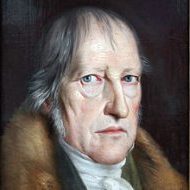
Author:
-
99
But the violation which befalls the will that exists in itself (and thus equally this will of the violator as much as of the violated and of all) has, in this will existing in itself as such, no positive existence, any more than in the mere product. For itself, this will existing in itself (right,…
-
100
|98| The violation that befalls the criminal is not only just in itself — as just, it is at the same time his will existing in itself, an existence of his freedom, his right — but it is also a right done to the criminal himself, that is, it is posited in his existent will,…
-
101
The sublation of crime is, to this extent, retribution, insofar as it is, according to the concept, a violation of the violation, and, according to existence, the crime has a determinate, qualitative and quantitative extent, and thus so too does its negation, as existence. This identity, resting on the concept, is however not the equality…
-
102
The sublation of crime, in this sphere of the immediacy of right, is at first revenge, just according to its content, insofar as it is retribution. |102| But according to its form, it is the act of a subjective will, which can put its infinity into every violation that has occurred, and whose justice is…
-
254
|239| The corporation involves a restriction of the so-called natural right to exercise one’s skill, and thereby to acquire what there is to acquire, only inasmuch as this right is, within the corporation, determined toward rationality — that is, liberated from one’s own opinion and contingency, from danger to oneself as well as to others,…
-
255
Together with the family, the corporation constitutes the second, ethical root of the state, one grounded in civil society. The former contains the moments of subjective particularity and objective universality in substantial unity; the latter, however, unites in an inward manner these same moments — which in civil society are initially divided into the self-reflected…
-
256
The purpose of the corporation, as a restricted and finite one — like the separation present in the external arrangement of the police, and its relative identity — has its truth in the purpose that is universal in and for itself, and in its absolute actuality; civil society therefore passes over into the state. Town…
-
257
|241| Third Section. The State The state is the actuality of the ethical Idea — ethical spirit as the revealed, self-transparent, substantial will, which thinks and knows itself and accomplishes what it knows, and insofar as it knows it. It has its immediate existence in custom, and its mediated existence in the self-consciousness of the…
-
258
|242| The state, as the actuality of the substantial will which it possesses in the particular self-consciousness raised to its universality, is that which is rational in and for itself. This substantial unity is an absolute, unmoved end in itself, in which freedom attains its supreme right — just as this ultimate end has the…
-
259
|250| |249| |248| |247| The Idea of the state: a) has immediate actuality and is the individual state as an organism relating itself to itself — constitution, or internal constitutional law; b) passes over into the relation of the individual state to other states — external constitutional law; c) is the universal Idea as genus…
-
260
|251| A. Internal Constitutional Law The state is the actuality of concrete freedom; but concrete freedom consists in this, that personal individuality and its particular interests not only achieve their complete development and gain recognition of their right for themselves (within the system of the family and of civil society), but also, on the one…
-
261
|252| In relation to the spheres of private right and private welfare, of the family and of civil society, the state is, on the one hand, an external necessity and their higher power, to whose nature their laws and interests are subordinate and on which they are dependent; but, on the other hand, it is…
-
262
The actual Idea, spirit, which divides itself into the two ideal spheres of its concept — the family and civil society — as into its finitude, in order to be, out of their ideality, infinite actual spirit for itself, thereby allots to these spheres the material of this its finite actuality, individuals as the mass,…
-
263
Within these spheres, in which its moments — individuality and particularity — have their immediate and reflected reality, spirit is present as their objective universality shining into them, as the power of the rational within necessity (§ 184), namely as the institutions considered above.
-
264
|255| The individuals of the mass, since they are themselves spiritual natures and thus contain within themselves the doubled moment — namely the extreme of individuality knowing and willing for itself, and the extreme of universality knowing and willing the substantial — and therefore attain the right of these two sides only in so far…
-
265
These institutions constitute, in the particular sphere, the constitution — that is, rationality developed and actualized — and are therefore the firm basis of the state, as well as of the confidence and disposition of individuals toward it, and the pillars of public freedom, since in them particular freedom is realized and rational, so that…
-
266
But spirit is objective and actual not merely as this necessity and as a realm of appearance, but as the ideality of this necessity and as its inner being; thus this substantial universality is an object and a purpose to itself, and that necessity is thereby equally present in the shape of freedom.
-
267
|256| Necessity within this ideality is the development of the Idea within itself; as subjective substantiality it is the political disposition, and as objective substantiality, in distinction from the former, it is the organism of the state — the properly political state and its constitution.
-
268
Political disposition, patriotism in general, as certainty grounded in truth (mere subjective certainty does not proceed from truth and is merely opinion) and as willing that has become habit, is only a result of the institutions subsisting within the state, in which rationality is actually present, just as this disposition acquires its practical activation through…
-
269
The disposition takes its particular determinate content from the different sides of the organism of the state. This organism is the development of the Idea into its differences and into their objective actuality. These differentiated sides are thus the different powers and their respective business and activities, through which the universal continually — since these…