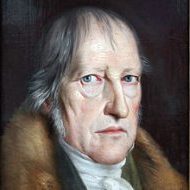
ON THE SCIENTIFIC WAYS OF TREATING NATURAL RIGHT, ITS PLACE IN PRACTICAL PHILOSOPHY, AND ITS RELATION TO THE POSITIVE SCIENCES OF RIGHT.
First published 1802/1803 in the “Kritisches Journal der Philosophie” (ed. Hegel and Schelling), vol. 2, issues 2 and 3. German text after: G.W.F. Hegel, Gesammelte Werke, vol. 4 (Jenaer Kritische Schriften), Hamburg 1968. Passages printed with letter-spacing (Sperrdruck) in the original are rendered here in italics. This is an original English translation prepared for this site.
The science of natural right, like other sciences such as mechanics and physics, has indeed long been recognized as an essentially philosophical science, and — since philosophy must have parts — as an essential part of it; but it has shared with the others the common fate that the philosophical element of philosophy was located in metaphysics alone, and little share in it was granted to them, so that they, in their particular principle, were kept wholly independent of the Idea; the sciences cited as examples have finally been compelled to confess, more or less, their distance from philosophy, so that they acknowledge what is customarily called experience as their scientific principle, thereby renouncing any claim to be true sciences, and content themselves with consisting of a collection of empirical items of knowledge, and with making use of the concepts of the understanding on sufferance, without wishing thereby to assert anything objective. If that which called itself philosophical science was, at first against its will, excluded from philosophy and from the category of science as such, and then in the end acquiesced in this position, this exclusion has its ground not in the fact that those so-called sciences did not proceed from the science of philosophy itself and did not maintain themselves in conscious connection with it; for every part of philosophy is capable, in its singularity, of being an independent science and of attaining a complete inner necessity, because that through which it is a true science is the Absolute; in which shape alone it is the peculiar principle that lies above the sphere of its cognition and its freedom, and in relation to which it belongs to an external necessity; but the Idea itself remains free of this determinacy, and is able to reflect itself in this particular science as purely as absolute life expresses itself in every living thing; without the scientific character of such a science, or its

Leave a Reply
You must be logged in to post a comment.